What is industrial supply ecommerce?
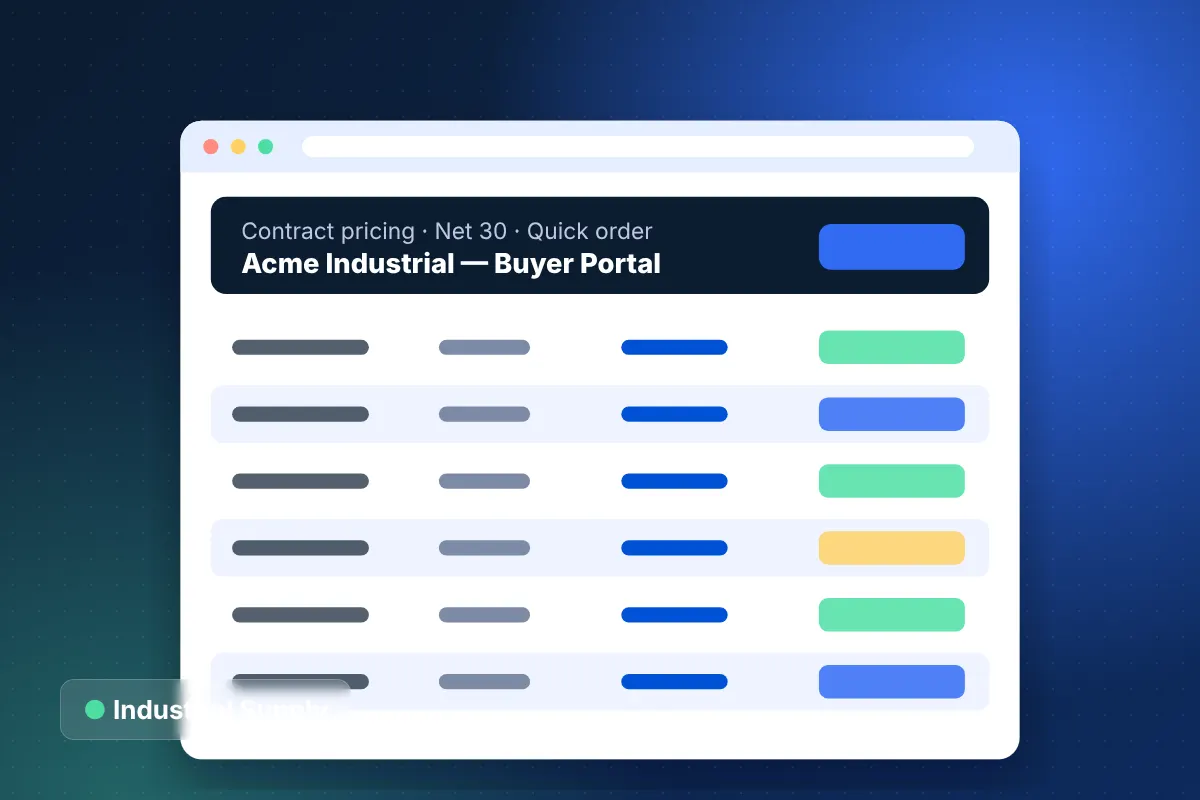
Industrial supply ecommerce is the online channel MRO and industrial distributors use to sell maintenance, repair and operations products to plants and contractors. It has to find the right part among hundreds of thousands, at the buyer's contract price, and route it through the buyer's approval process.
MRO ecommerce is search-first. A maintenance technician with a down conveyor does not browse categories; they search a part number, a competitor's number or a few specs and expect the exact match or a valid substitute in seconds. Everything in the build serves that moment.
How industrial buyers behave
- Urgent, unplanned purchases: breakdowns create time-critical orders where availability matters most.
- Spec-driven search: buyers filter by thread size, voltage, material, pressure rating and similar attributes.
- Procurement control: plants enforce approved catalogs, budgets and approval chains.
- Tail spend: many low-value, high-frequency items that procurement wants consolidated with fewer suppliers.
Must-have features for industrial B2B ecommerce
The must-have features are about findability, control and speed of fulfillment. They make your portal the easiest place for a plant to buy.
- Technical attribute search: normalized specs across suppliers so filters work consistently.
- Cross-reference lookup: competitor, OEM and manufacturer part numbers mapped to your SKUs.
- Substitutes and alternates: equivalent items suggested when the first choice is out of stock.
- Punchout catalogs: cXML and OCI connections to Ariba, Coupa, Jaggaer and SAP.
- Plant budgets and approvals: spending limits by user, department and cost center.
- Branch availability and will-call: stock by branch with same-day pickup.
- Storeroom and VMI tools: bin lists, scan-to-reorder and vendor-managed inventory replenishment.
- Documents on demand: SDS, spec sheets, certifications and invoices per order.
Which platform is best for industrial supply ecommerce?
Adobe Commerce and custom headless portals handle the largest MRO catalogs best, while BigCommerce B2B Edition suits mid-sized distributors. Search performance and ERP integration usually decide.
| Platform | Best for |
|---|---|
| Adobe Commerce B2B | Large catalogs, shared catalogs per account and complex pricing |
| BigCommerce B2B Edition | Mid-size distributors with standard B2B needs |
| Custom headless portal | Hundreds of thousands of SKUs, punchout and deep ERP logic |
| Salesforce B2B Commerce | Distributors centered on Salesforce for sales and service |
Our Magento development services and B2B ecommerce development teams scope platform choice against your catalog data and ERP before any recommendation.
Search, data and integrations for MRO ecommerce
MRO ecommerce succeeds or fails on product data quality and search. Integrations keep that data, plus pricing and stock, accurate every hour of the day.
We normalize supplier data into a consistent attribute model, then index it in a search engine tuned for part numbers, abbreviations and units. AI search helps interpret queries like "1/2 NPT brass ball valve 600 WOG" and handles misspellings common on plant floors.
- ERP integration for pricing, branch inventory and orders through ecommerce ERP integration
- Supplier content and PIM feeds
- Procurement networks and punchout
- Barcode scanning and VMI systems
- Freight and carrier rate shopping
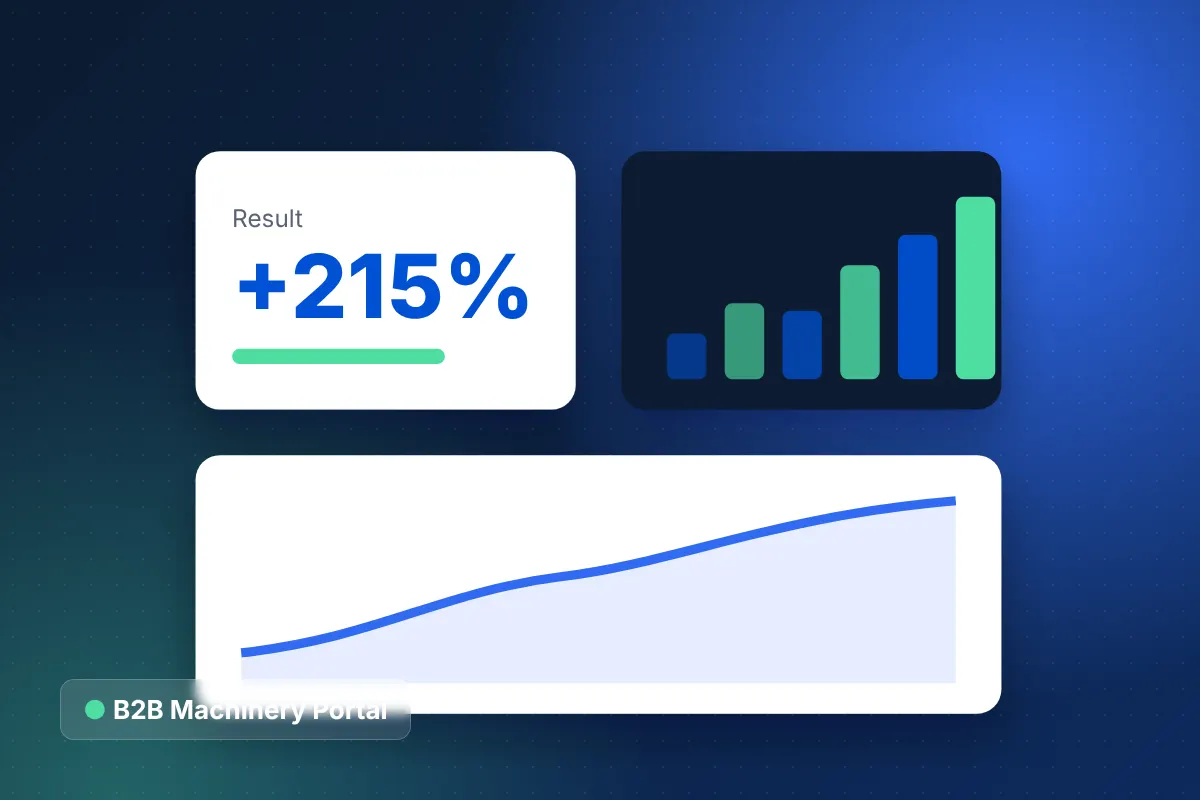
For an industrial OEM with 120,000+ SKUs, we delivered a custom B2B punchout store integrated with SAP S/4HANA that increased digital order volume by 215% and saved 40 hours of admin each week. See the B2B ecommerce case study.
Compliance considerations for industrial supply
Industrial distributors handle hazardous materials, restricted products and documentation requirements every day. The portal should apply those rules automatically by item and destination.
- Hazmat shipping: flags for flammables, compressed gases and corrosives with ground-only or restricted services.
- Safety data sheets: SDS attached to products and included with orders.
- Restricted and controlled items: products limited by license, region or account type.
- Tax exemptions: resale and manufacturing exemption certificates stored per account.
- Accessibility and security: WCAG 2.2 AA screens, SSO and role-based access.
Industrial supply ecommerce from a Houston-based team
Houston's industrial economy, from refineries and chemical plants along the Ship Channel to fabrication shops and MRO distributors across the region, shapes how our team thinks about B2B. We understand plant procurement, branch networks and urgent breakdown orders, and we build for distributors across the US.
Builds follow our six-phase process over 8–16 weeks: Discovery & Strategy, Conversion UX/UI Design, Architecture & API Engineering, Custom Development, Testing & Optimization and Zero-Downtime Launch. Industrial portals with large catalogs and deep integrations usually fall in the $60,000–$150,000+ range, under fixed-price milestones.
Get a free industrial supply ecommerce estimate
If plant buyers cannot find parts on your site, they will find them somewhere else. Size your project with the ecommerce website cost calculator, then book a free 30-minute strategy call to plan your industrial supply ecommerce portal.