What are online marketplace platform solutions?
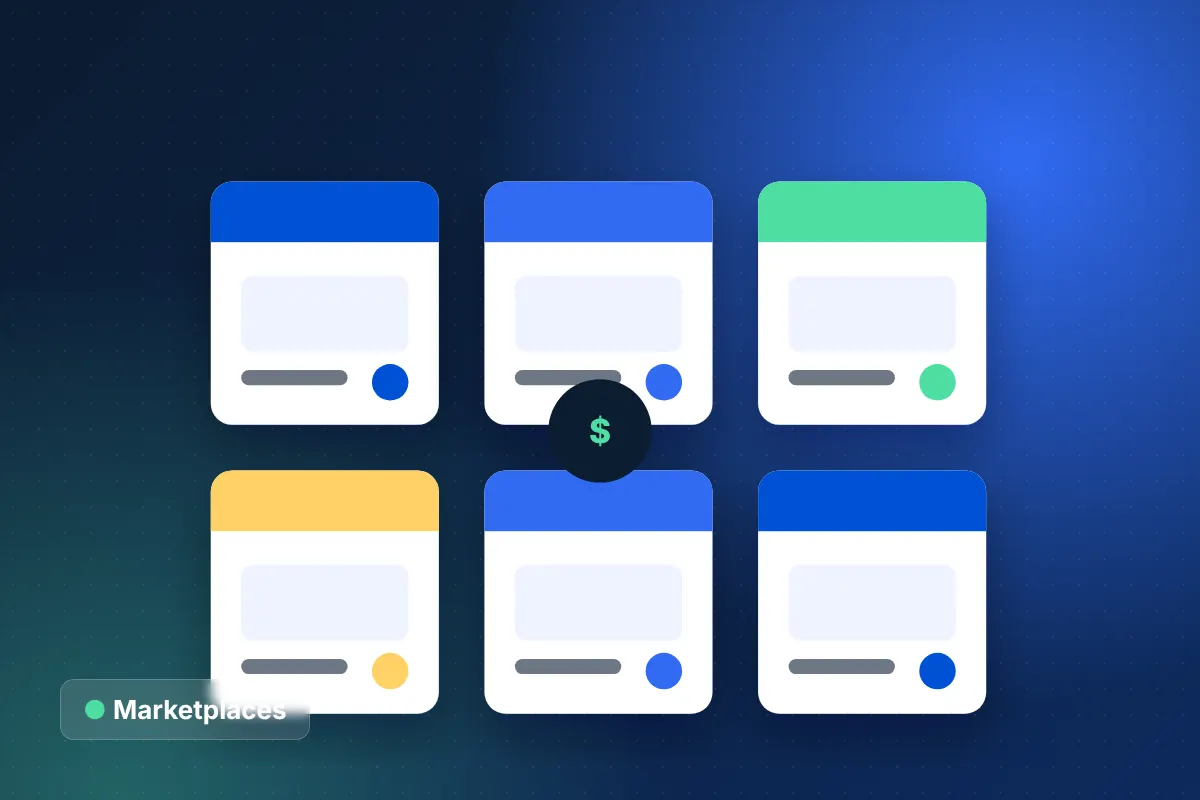
Online marketplace platform solutions are the software and processes that let a business host many sellers on one site. Buyers search one catalog, check out once and pay one total, while behind the scenes each order is split among vendors, commissions are deducted and payouts are scheduled.
The model is attractive because you grow the catalog without buying inventory. It is also harder to build than a single-brand store. You now serve two customers, buyers and sellers, and both sides need a reason to stay. The technology has to make selling easy for vendors and buying trustworthy for shoppers.
We build marketplaces for consumer niches, B2B supply categories and brands that want to add curated third-party products alongside their own range.
Good online marketplace platform solutions start with the business rules, not the software. Who owns the customer relationship? Who handles returns? When does a vendor get paid, and what happens to their payout when a buyer disputes a charge? Answering these questions in discovery prevents expensive rework after launch.
Which marketplace models can we build?
We build product marketplaces, B2B supplier marketplaces and hybrid stores that mix first-party and third-party inventory. The model you choose shapes payments, fulfillment and catalog control.
- Multi-vendor product marketplace: independent sellers list and ship their own products; you take a commission.
- B2B supplier marketplace: verified suppliers sell to business buyers with quotes, tiered pricing and invoicing.
- Hybrid retail marketplace: your own catalog plus curated partner products, often drop-shipped.
- Niche or regional marketplace: a focused category or geography where trust and curation beat sheer catalog size.
What features does a multi-vendor marketplace need?
A multi-vendor marketplace needs strong vendor tools, reliable payments and buyer trust features. Missing any one of these slows growth on both sides of the market.
Vendor side
- Self-service onboarding with identity and business verification (KYC/KYB).
- Seller dashboard for listings, bulk product import, inventory, orders and returns.
- Payout history, fee statements and performance reports.
Buyer side
- Unified search, filters and product comparison across all vendors.
- One cart and one checkout, even when items come from several sellers.
- Seller ratings, product reviews, messaging and a clear dispute process.
Operator side
Your team needs listing approval queues, catalog quality rules, a commission and fee engine, vendor tiers, and reporting on gross merchandise value, take rate and seller performance. These admin tools decide how much the marketplace costs to run as it scales.
Catalog quality deserves special attention. When dozens of vendors upload products, you get duplicate listings, inconsistent attributes and poor images. We build import templates, attribute validation and approval rules so search and filters keep working as the catalog grows, which is where many online marketplace platform solutions quietly break down.
How do marketplace split payments and payouts work?
Marketplace payments collect one charge from the buyer, then split it into vendor shares and your commission, holding or releasing funds according to your rules. Stripe Connect is the most common way to do this, and PayPal offers marketplace payments as well.
- The buyer pays one total at checkout.
- The order is split into sub-orders by vendor.
- The commission engine calculates your fee per line, category or vendor tier.
- Funds are held until shipment, delivery or a return window passes (escrow-style flows).
- Vendor payouts run on a schedule, with refunds and chargebacks deducted automatically.
Our payment gateway integration services cover Stripe Connect onboarding, payout schedules and reconciliation so finance can trace every dollar from buyer to vendor. Sales tax, seller tax reporting and payment compliance requirements vary by country and state, so we plan them with your accountants and legal advisors during discovery.
Build or buy: which marketplace platform should you use?
Choosing among online marketplace platform solutions comes down to how unique your model is and how fast you need to launch. Off-the-shelf marketplace software is quicker, while custom builds give full control over fees, workflows and data.
| Approach | Strengths | Limitations |
|---|---|---|
| Marketplace app on Shopify or BigCommerce | Fast start, familiar admin, strong checkout | Vendor tools and payout logic bounded by the app |
| Adobe Commerce with marketplace extensions | Large catalogs, deep customization | Extension quality varies; heavier maintenance |
| Dedicated marketplace software | Mature vendor and operator features | License costs; less flexibility in the buyer experience |
| Custom or headless marketplace | Any commission model, any workflow, full data ownership | Larger upfront build |
For a hands-on build, see our multi vendor marketplace development service. Many marketplaces pair a custom vendor layer with a headless storefront; our guide to what is headless commerce explains when that split makes sense.
How much do online marketplace platform solutions cost?
Custom marketplace builds usually fall in our $60,000 to $150,000+ band because they include vendor portals, payments and operator tooling. Focused marketplaces on an existing platform with a scoped feature set can land in the $25,000 to $60,000 range.
The main cost drivers are the commission and payout model, vendor onboarding and verification, catalog import tools, B2B features such as quoting, and integrations with shipping, tax and accounting systems. We price fixed milestones after discovery and often phase the launch: a minimum viable marketplace with a small group of founding sellers first, then advanced vendor features once demand is proven.
How we launch a marketplace without stalling either side
We follow the same six phases as every project, typically over 8 to 16 weeks for a first release, with extra attention to seeding supply before buyers arrive.
- Discovery covers your commission model, vendor contract terms and launch categories.
- UX design runs separately for buyers, vendors and your operations team.
- Architecture defines payments, order splitting and data ownership up front.
- Testing uses real vendor accounts and real payouts in sandbox mode before going live.
From our Houston, Texas office we have delivered 350+ ecommerce projects over 15+ years, and you own 100% of the marketplace code and IP we write. After launch, 24/7 monitoring and a 15-minute critical response protect checkout and payouts, because a payout delay damages vendor trust faster than almost anything else. We also review take rate, vendor activity and buyer conversion with you in the first months so the online marketplace platform solutions we deliver keep improving with real data.
Start your online marketplace project
The right online marketplace platform solutions depend on your model, your sellers and your launch timeline. Book a free 30-minute strategy call to pressure-test your commission and payout model, or get a first ballpark with the ecommerce website cost calculator.