The client & challenge: 120,000 SKUs sold by phone and email
An industrial OEM sold a catalog of more than 120,000 SKUs with tier-dependent contract pricing almost entirely by phone and email. Sales staff re-keyed orders into SAP by hand, and buyers waited for quotes.
That model created friction on both sides. Buyers could not check their own prices or stock, so routine reorders became calls and emails. Internally, skilled staff spent hours each week typing orders into the ERP, with every manual step adding a chance of error.
- A 120,000+ SKU catalog with customer-specific, tier-dependent pricing.
- Orders arriving by phone and email, then re-keyed into SAP.
- Slow quote turnaround for buyers.
- Procurement teams wanting to order from their own systems.
Our approach to building the SAP-integrated B2B portal
We built a custom B2B punchout store connected bidirectionally to SAP S/4HANA. The ERP stayed the single source of truth, and the portal became the self-service front door for buyers.
- Real-time ERP data: contract prices, stock and order status flow from SAP in real time.
- Company accounts: buyers get company accounts with approval workflows.
- Instant RFQ and invoices: request-for-quote and invoice generation happen instantly instead of by email.
- Punchout: procurement teams can punch out from their own systems using cXML.
- Middleware: a Node.js integration layer handles mapping, queuing and error recovery between portal and ERP.
The integration work follows our sap ecommerce integration methodology, and the portal itself was delivered through our b2b ecommerce development practice.
Designing for buyers, not browsers
B2B buyers come to a portal with a job to do. We designed the ordering experience around speed: search that understands part numbers, account-specific pricing visible on every product, and approval steps that match how the customer's own purchasing works. Consumer-style merchandising was secondary to accuracy and fast reordering.
Making the ERP the single source of truth
Rather than copying SAP data into a separate commerce database and hoping it stayed in sync, the middleware treated SAP S/4HANA as authoritative. The portal requests prices, stock and order status as needed and sends orders and quote requests straight back, with queuing and error recovery so a short ERP outage does not lose an order.
Technology stack behind the B2B punchout store
The architecture keeps SAP as the system of record and uses middleware to keep the storefront fast and resilient.
| Layer | Technology | Role in the build |
|---|---|---|
| ERP | SAP S/4HANA | System of record for pricing, stock, orders and invoices |
| Storefront | Custom B2B storefront | Company accounts, approvals, RFQ and ordering |
| Procurement | Punchout (cXML) | Ordering from buyers' own procurement systems |
| Integration | Node.js middleware | Bidirectional, real-time sync between portal and SAP |
Results of the B2B ecommerce portal
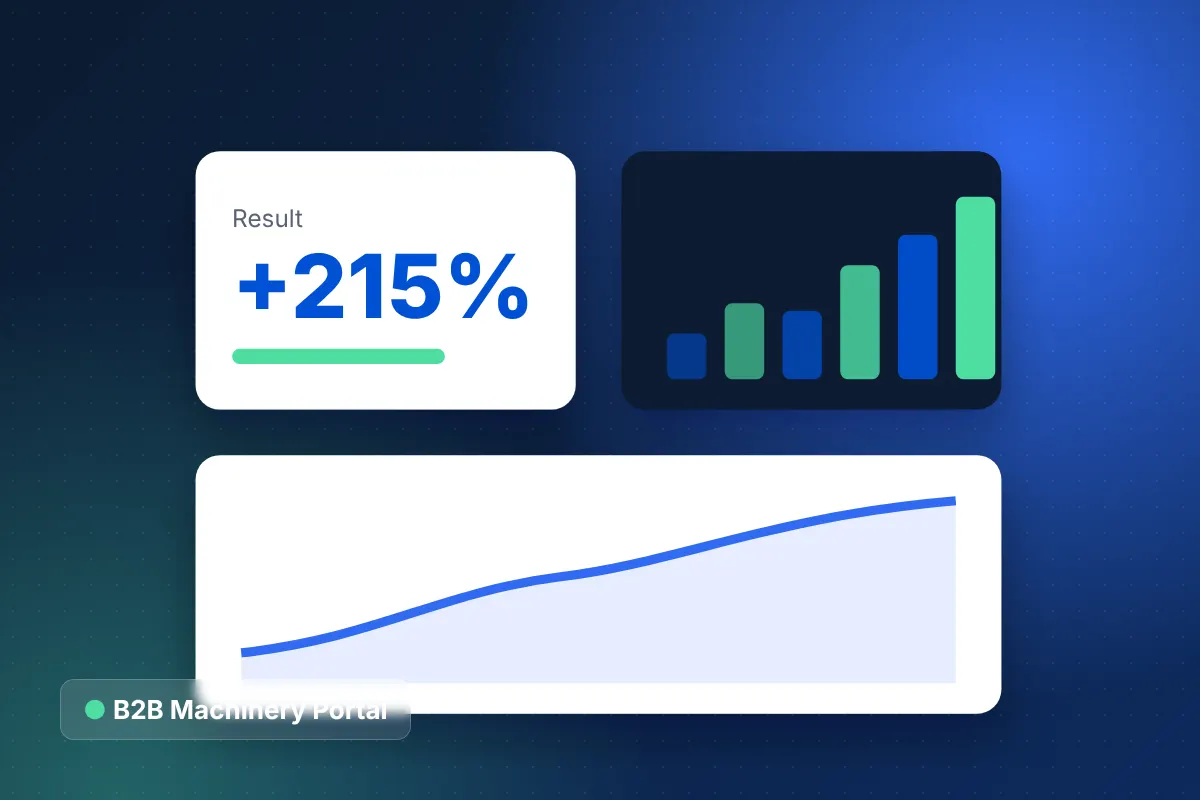
Moving routine ordering online had an immediate effect on volume and workload. Digital order volume rose 215%, and the team saved 40 hours of administrative work each week.
- +215% digital order volume.
- 40 hours of weekly admin saved.
- Real-time contract pricing, stock and order status for buyers.
- Instant RFQ and invoice generation.
The portal also changed the quality of data in SAP. Orders arrive structured and complete, rather than transcribed from emails, which reduces correction work for customer service and finance.
Sales staff now spend less time re-keying and more time on accounts, while buyers get answers without waiting for a callback.
What other B2B brands can learn from this case study
B2B portals succeed when they mirror existing commercial rules and remove manual work, rather than forcing buyers into a consumer-style checkout.
- Integrate deeply. Real-time ERP sync is what removes re-keying and builds buyer trust.
- Respect contract pricing. Buyers must see their own price, every time.
- Meet procurement where it works. Punchout matters to large accounts.
- Automate quotes. Instant RFQs shorten the sales cycle.
It also helps to involve sales early. When reps see the portal as a tool that removes admin rather than a threat to their accounts, they actively move customers online, and adoption grows much faster.
Manufacturers exploring this path should also read our guide to manufacturing ecommerce solutions and our comparison of the best b2b ecommerce platform options.
Start your B2B ecommerce project
If your team still re-keys orders into the ERP, a portal like this can change the economics of every order. Book a free 30-minute 1:1 strategy call and receive a free project estimate.
Book a free ecommerce strategy call to discuss your ERP, catalog and pricing. This b2b ecommerce case study shows what a disciplined integration can achieve.
“Our industrial parts catalog contains over 120,000 SKUs with tier-dependent contract pricing. They built a custom B2B storefront connected to our SAP system that reduced phone quote requests by 65%.”