What is AI ecommerce development?
AI ecommerce development means building AI features into your store that solve specific commercial problems: shoppers who cannot find products, generic merchandising, slow customer service and thin product content. It is engineering work, not a plug-in that promises magic.
At Custom Ecommerce, we approach AI the way we approach any integration after 15+ years in commerce engineering. We start with the metric you want to move, connect the right data, choose proven models and APIs, and measure the result against a control group.
Where AI pays off first in ecommerce
- Search: understanding natural-language queries and synonyms instead of exact keyword matching.
- Recommendations: showing relevant products based on behavior, purchase history and product similarity.
- Customer service: answering order, sizing and policy questions instantly, with clean handoff to humans.
- Content operations: generating and enriching product descriptions, attributes and translations at scale.
- Operations: demand forecasting, anomaly alerts and fraud signals that support existing teams.
AI search and product recommendations: how they lift conversion
AI search and recommendations shorten the path from intent to product, which is where most stores leak revenue. Both rely on the same foundation: complete product data and reliable behavioral events.
Semantic product search
AI search uses vector embeddings and language models to match what shoppers mean, not just what they type. A query like "waterproof boots for a wide foot" should return relevant results even when no product title contains those exact words.
We implement semantic and hybrid search with platforms such as Algolia NeuralSearch, Elasticsearch or OpenSearch with vector indexes, and Typesense, blending keyword precision with semantic recall. Merchandisers keep control through boosting rules, pinned results and synonym management.
Search quality also depends on clean product data. We often pair AI search with catalog enrichment so attributes like material, fit and use case are complete before they are indexed.
AI product recommendations and personalization
AI product recommendations suggest items each shopper is likely to want, based on browsing, cart and purchase signals. The goal is relevant cross-sells and faster discovery, not more widgets on the page.
Recommendation types we build include:
- "Frequently bought together" bundles on product and cart pages.
- Similar items based on visual and attribute similarity.
- Personalized homepage and category sorting for returning customers.
- Replenishment reminders timed to typical reorder cycles.
- Post-purchase recommendations in email and account pages.
Personalization depends on trustworthy data, so we often start with GA4 ecommerce tracking setup and server-side events before training or configuring any model. Consent settings are respected throughout.
Building an AI chatbot for ecommerce that shoppers trust
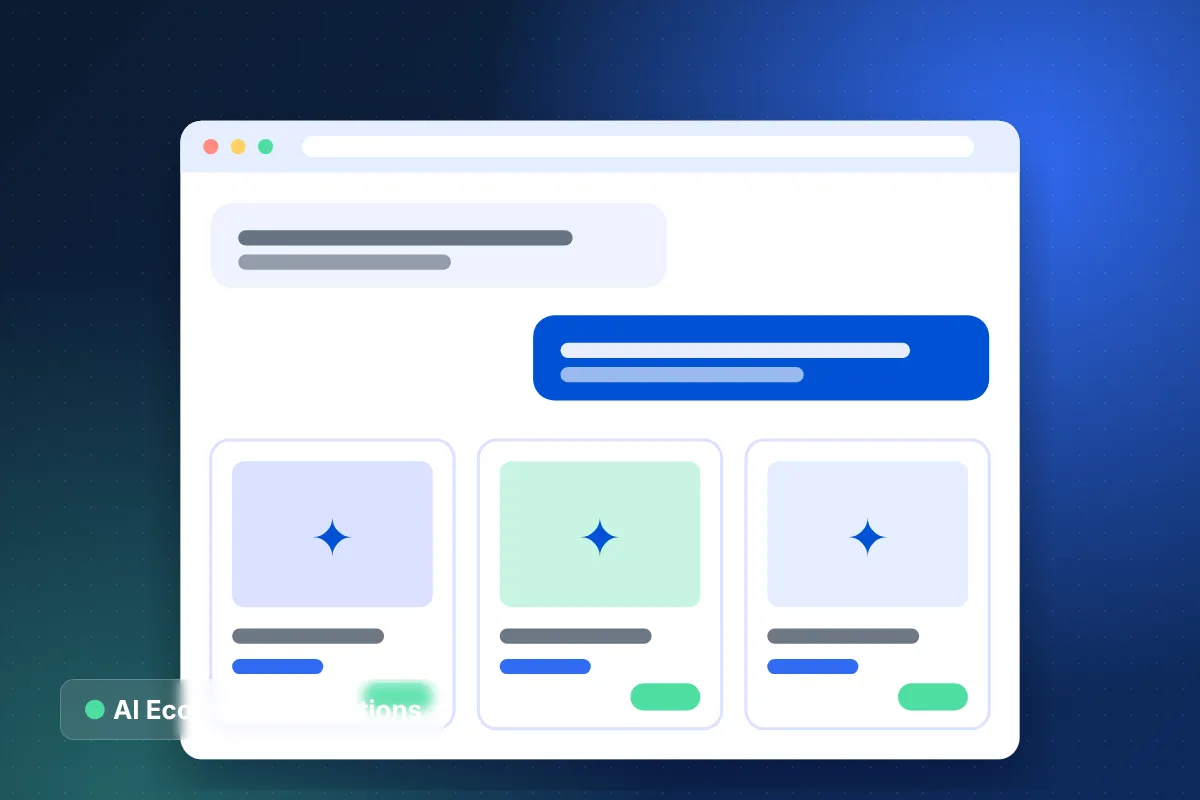
A useful AI chatbot for ecommerce answers questions from your real catalog, policies and order data, and hands off to a person when it should. We build assistants with retrieval-augmented generation (RAG) so responses are grounded in approved sources rather than the model's general knowledge.
Typical capabilities include product finders that ask clarifying questions, sizing and compatibility help, order-status lookups through authenticated APIs, and return initiation. For B2B stores, assistants can search spec sheets, check part compatibility and draft quote requests.
Guardrails we put in place
Every assistant ships with scoped data access, prompt-injection defenses, restricted actions, logging for review and clear disclosure that the shopper is talking to AI. We never let a model invent prices, stock levels or policy terms; those always come from live systems.
We also define what success looks like before launch: the share of conversations resolved without an agent, the accuracy rate on a test set of real customer questions, and the conversion rate of shoppers who use the assistant compared with those who do not. If an assistant is not helping, the data will show it quickly.
AI tools for catalogs and merchandising teams
Behind the storefront, AI saves time on repetitive catalog work. The aim is to help your team publish more accurate content faster while keeping humans in charge of approval.
| Use case | What AI does | Human role |
|---|---|---|
| Product descriptions | Drafts on-brand copy from attributes and supplier data | Review, edit and approve before publishing |
| Attribute extraction | Pulls specs from PDFs, images and supplier feeds into structured fields | Spot-check accuracy for key categories |
| Image tagging and alt text | Generates descriptive tags and accessibility-friendly alt text | Confirm accuracy and tone |
| Translation and localization | Produces first drafts for new markets | Native-speaker review on priority pages |
| Review summaries | Condenses customer reviews into pros and cons | Set rules for what is displayed |
AI-generated content still needs to meet search quality standards, so we coordinate with our ecommerce SEO services team on structure, uniqueness and indexing.
How we deliver AI ecommerce development projects
We deliver AI features through our six-phase process with fixed-price milestones, starting small and expanding what works. Most first releases fit inside our typical 8 to 16 week window.
- Discovery and strategy: pick one or two use cases tied to measurable outcomes such as search conversion or support deflection.
- Data readiness: audit product data, event tracking and content sources, and fix gaps that would undermine results.
- Architecture: choose between platform-native AI, specialized SaaS and custom LLM pipelines on providers such as OpenAI, Anthropic or AWS Bedrock.
- Build and integrate: connect AI services to your storefront, often through a headless commerce development architecture that makes new services easier to add (see what is headless commerce for the background).
- Test and evaluate: run accuracy tests, red-team the assistant and A/B test against your current experience.
- Launch and monitor: roll out gradually, review logs and tune prompts, ranking rules and models over time.
Your data stays yours. We configure providers so store data is not used to train public models where those settings exist, and you own 100% of the code we write.
How much does AI ecommerce development cost?
AI ecommerce development is scoped after a free strategy call, because cost depends on the use case, data readiness and whether you use SaaS tools or custom pipelines. Focused projects start around $15,000, and AI is often added within larger builds in the $25,000 to $60,000 range.
Ongoing model usage, search platform and API fees are billed by those providers and scale with traffic. We estimate them during discovery so there are no surprises. For a broader budget view, use our ecommerce website cost calculator.
Why choose our AI ecommerce development team
We combine AI engineering with deep commerce platform experience: 350+ ecommerce projects, 24+ verticals and partner status with Shopify Plus, Adobe Commerce and BigCommerce. That means AI features are built to work with your checkout, catalog and integrations, not bolted on.
Our Houston, Texas team follows ISO 27001 aligned security practices and AWS Well-Architected principles, which matter when AI systems touch customer data. After launch, 24/7 monitoring and a 15-minute critical response SLA cover AI services like any other production system.
Get a free AI ecommerce development estimate
If you want AI that improves search, conversion or service rather than adding novelty, we will help you choose the right first use case and build it properly. Our AI ecommerce development work starts from your goals and your data.
Book a free 30-minute strategy call to get a free project estimate. We reply within 24 hours and sign a mutual NDA on request.