What is Amazon integration for ecommerce?
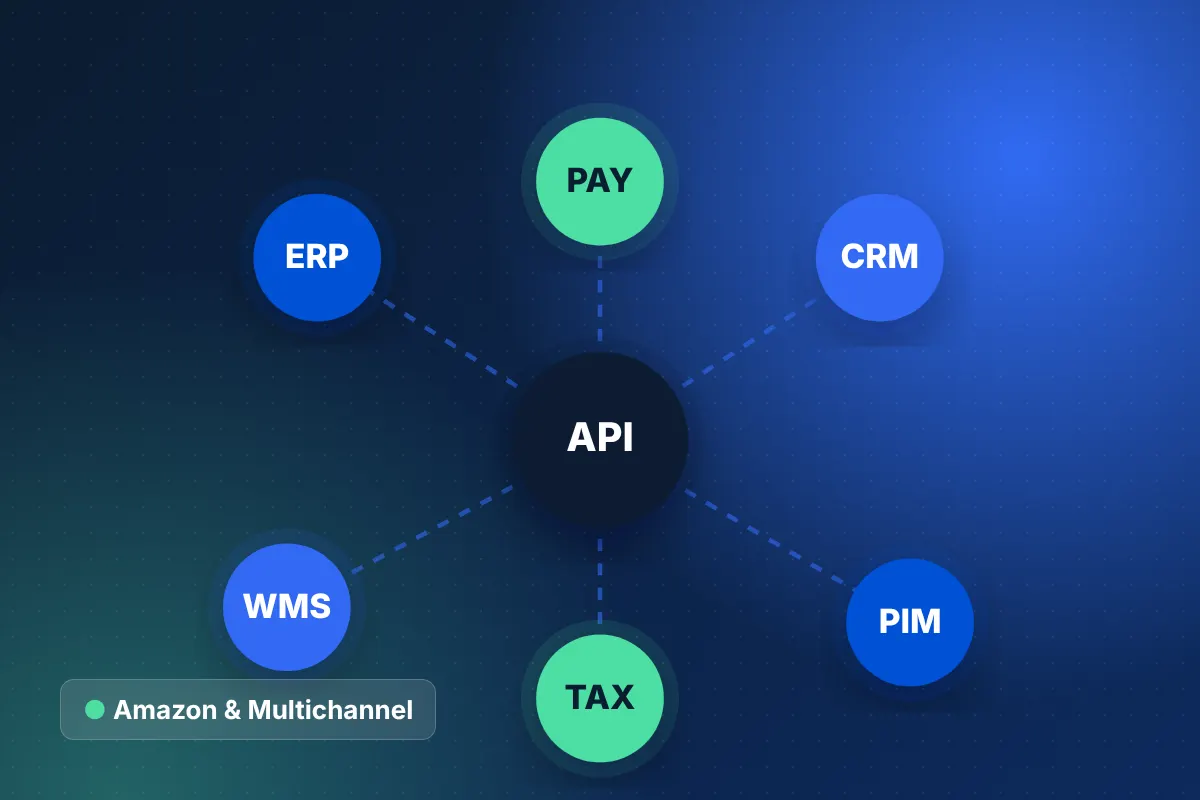
Amazon integration for ecommerce links your Shopify, Adobe Commerce, BigCommerce, WooCommerce or custom store with Amazon so data moves automatically in both directions. Products and stock flow out to Amazon; orders, fees and returns flow back into your systems.
Without it, teams update listings by hand, oversell when stock runs low on one channel, and spend hours re-keying marketplace orders. Custom Ecommerce brings 15+ years of commerce engineering to building these connections so they hold up under real order volume.
What gets synchronized
- Listings: titles, bullet points, images, attributes, variations and category-specific required fields.
- Inventory: available quantities from your ERP, warehouse or store, with safety buffers per channel.
- Pricing: channel-specific prices, sale prices and minimum advertised price rules.
- Orders: marketplace orders imported into your store, ERP or order management system for fulfillment.
- Fulfillment and returns: tracking numbers sent back to the marketplace, and returns and refunds recorded centrally.
Which marketplaces and sales channels do you integrate?
We integrate the major US marketplaces and social commerce channels alongside your own store. Each has different APIs, catalog rules and performance metrics, so we design the integration around the channels that matter to your margin.
| Channel | Integration method | Key considerations |
|---|---|---|
| Amazon | Selling Partner API (SP-API) | Product type templates, brand registry, FBA vs FBM, shipping performance metrics |
| Walmart Marketplace | Walmart Marketplace APIs | Strict item spec requirements, price competitiveness, on-time shipping standards |
| eBay | eBay Sell APIs | Item specifics, business policies, multi-variation listings |
| TikTok Shop | TikTok Shop Partner APIs | Fast-moving promotions, creator affiliate orders, fulfillment time limits |
| Google and Meta | Merchant Center and catalog feeds | Feed quality, product identifiers, shopping ad eligibility |
Amazon listing quality and account health
Amazon penalizes listings with missing attributes, suppressed images or inaccurate stock, and it measures sellers on late shipments and cancellations. Our Amazon integration for ecommerce validates product data against the correct product type before submission, surfaces listing errors in a readable report, and protects account health by keeping quantities and handling times honest.
Brand-registered sellers also get support for A+ content workflows and variation families, so parent and child products stay grouped correctly as your catalog grows.
eBay and Walmart integration
Walmart and eBay each reward accurate data and reliable shipping. We map your attributes to their item specs, enforce lag times that match your real fulfillment speed, and route orders into the same pipeline as Amazon and your website.
TikTok Shop integration
TikTok Shop moves quickly, with flash promotions and creator-driven spikes. We sync inventory with conservative buffers and import orders frequently so viral demand does not turn into cancellations.
Connector app or custom integration: which is right for your business?
Use a multichannel connector app when your catalog is simple and volumes are moderate. Choose a custom or hybrid integration when you have large catalogs, ERP-driven inventory, bundles, B2B rules or multiple warehouses.
- Connector apps such as ChannelAdvisor (Rithum), Feedonomics, Linnworks or Cedcommerce are quick to start and handle common listing tasks.
- Custom SP-API integrations give full control over listing logic, inventory allocation and order routing, and you own 100% of the code.
- Hybrid setups use a feed tool for listings and custom middleware for inventory and orders, which is often the most cost-effective path for growing brands.
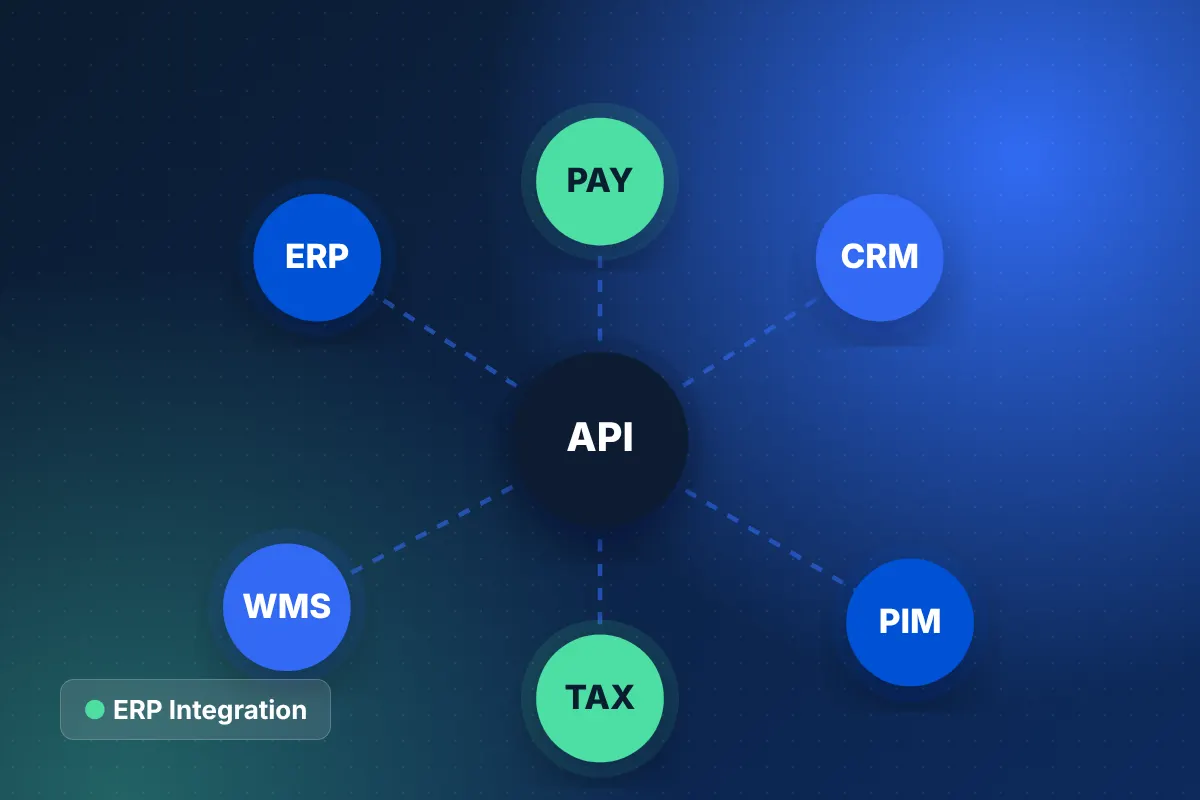
Inventory accuracy usually depends on your ERP. Our ecommerce ERP integration work makes the ERP or warehouse system the single source of stock, then publishes allocated quantities to each channel.
How Amazon integration for ecommerce prevents overselling
Overselling happens when channels draw from the same stock without a shared, near real-time count. We fix it with one inventory pool, event-driven updates and channel buffers.
- Single source of truth: one system owns available-to-sell quantities, usually your ERP, WMS or order management system.
- Event-driven sync: every sale, return or receipt triggers an update to all channels within minutes, not overnight.
- Allocation rules: reserve stock for your own site, cap quantities on marketplaces, or hold back units for wholesale orders.
- Bundles and kits: calculate sellable quantities from component stock so a bundle never sells when one part is out.
- Reconciliation: scheduled full syncs correct drift, and alerts flag listings that fall out of sync.
For FBA sellers, we pull Amazon fulfillment inventory and fees back into your reporting, so you see true channel profitability rather than gross sales alone.
The same rules handle returns. When a marketplace return is received and inspected, the unit goes back into the shared pool automatically, or into a separate grade if it cannot be resold as new. Customer service sees every order, from every channel, in one place.
Our multichannel ecommerce integration process
We deliver channel integrations through the same six-phase process we use for full store builds, on fixed-price milestones. Most projects fit inside our 8 to 16 week delivery window, and simpler connector rollouts finish sooner.
- Discovery and strategy: channel priorities, catalog audit, fulfillment model and margin goals.
- Data design: attribute mapping to each marketplace's product type and item spec requirements.
- Architecture and API engineering: connector, custom or hybrid design, plus queues, retries and logs.
- Development: listing, inventory, pricing, order and fulfillment flows.
- Testing: sandbox orders, stock edge cases, cancellations and returns on every channel.
- Launch: phased channel activation and monitoring of listing errors and account health.
Once channels are live, accurate attribution matters. Pair your rollout with GA4 ecommerce tracking setup so you can compare website and marketplace performance properly.
How much does Amazon and marketplace integration cost?
Marketplace integration is scoped after a free strategy call because cost depends on channel count, catalog size and how much custom logic you need. Smaller connector-led projects start around $15,000, while ERP-driven multichannel programs typically fall in the $25,000 to $60,000 band or above.
The main drivers are the number of channels, SKU and variation count, data cleanup needed to meet marketplace specs, ERP or WMS connections, and FBA reporting. Connector subscription fees and marketplace selling fees are separate and set by those providers. For a quick range, use our ecommerce website cost calculator.
Why brands choose us for multichannel ecommerce
We have delivered 350+ ecommerce projects across 24+ verticals, and we hold Shopify Plus Certified Partner, Adobe Commerce Solution Partner and BigCommerce Elite Partner status, so we understand both sides of the integration. On our Magento to Shopify Plus migration case study, we unified 8 regional stores into one headless architecture, the same kind of data consolidation that makes multichannel selling manageable.
Our team works from Houston, Texas with brands across the US and internationally. After launch, 24/7 monitoring and a 15-minute critical response SLA keep orders flowing during peak events like Prime Day and the holiday season.
Start your Amazon integration for ecommerce project
If channel growth is creating more spreadsheets than sales, a well-designed Amazon integration for ecommerce will give you one catalog, one inventory pool and one order pipeline across every marketplace.
Book a free 30-minute strategy call and get a free project estimate. We reply within 24 hours and can sign a mutual NDA before reviewing your data.