What is progressive web app ecommerce?
Progressive web app ecommerce is a storefront engineered as a PWA, so it loads like a website but behaves like a native app. Shoppers reach it through search or a link, then can add it to their home screen with one tap.
Under the hood, a PWA combines a web app manifest, a service worker and a JavaScript front end that renders pages instantly after the first visit. Custom Ecommerce has spent 15+ years in commerce engineering, and we build PWAs when mobile traffic is high, repeat purchase matters and a separate native app is hard to justify.
The three building blocks of an ecommerce PWA
- Web app manifest: defines the icon, name, splash screen and standalone display mode used when the store is installed.
- Service worker: a background script that caches the app shell, product data and images so repeat views are near instant and browsing survives a dropped signal.
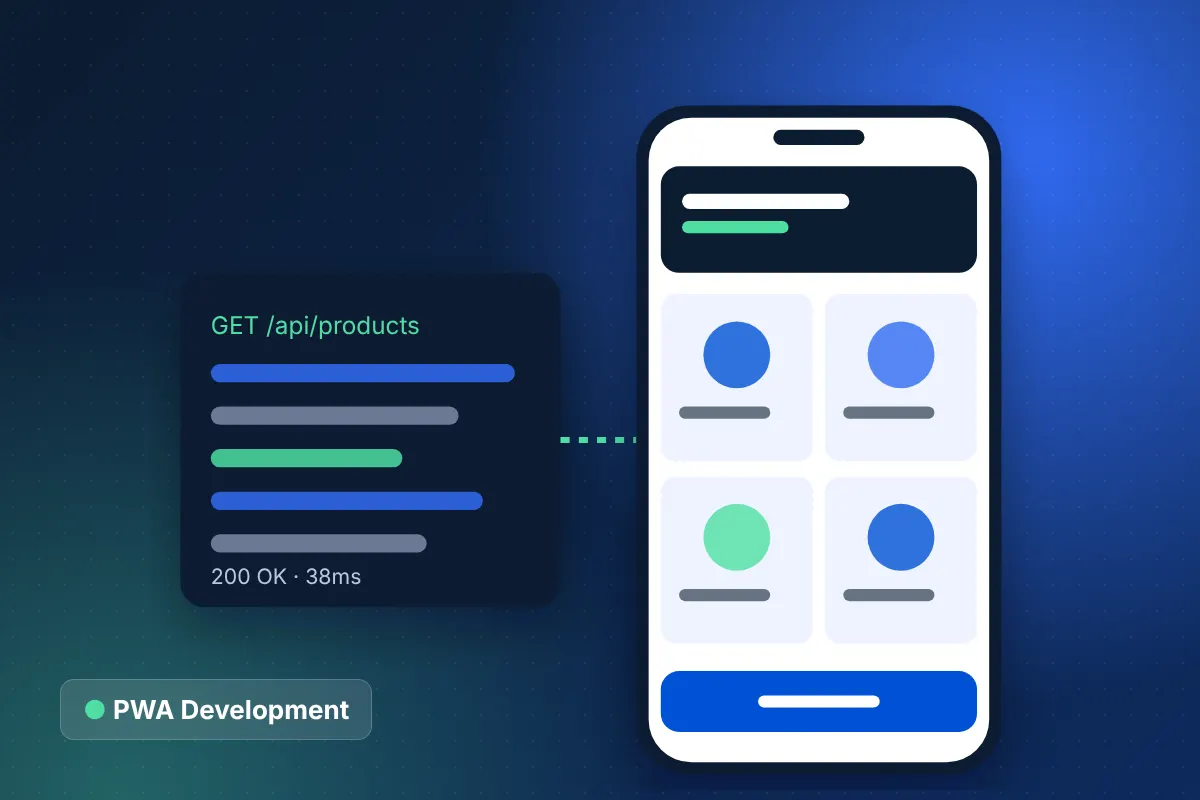
- App-shell front end: usually React, Next.js or Vue Storefront, fetching catalog, cart and customer data from your commerce platform over APIs.
Why choose a PWA for your ecommerce store?
A PWA is worth it when mobile shoppers drive most of your revenue and page speed is holding conversion back. It gives you an app-like experience without paying to build and maintain separate iOS and Android apps.
The practical benefits we design for:
- Faster repeat sessions: cached shells and client-side routing make category and product navigation feel instant.
- No install barrier: shoppers start buying on the web and choose to install later, so you never lose a first-time visitor to an app store page.
- One codebase: desktop, mobile web and the installed experience share the same front end and release cycle.
- Re-engagement: web push notifications for back-in-stock, price drops and abandoned carts, with opt-in handled responsibly.
- Indexable pages: with server-side rendering, every product and category stays crawlable for search engines.
Speed is the core of the value. We target Google's Core Web Vitals thresholds (LCP ≤ 2.5s, INP ≤ 200ms, CLS ≤ 0.1) from the first sprint, and pair builds with our ecommerce speed optimization practice when an existing store needs to be rescued first.
PWA vs native app vs responsive site: which is right for you?
For most mid-market brands, a progressive web app ecommerce storefront delivers the best balance of reach, speed and cost. A native app makes sense when you need deep device features or have a very loyal, high-frequency customer base.
| Factor | Responsive website | Ecommerce PWA | Native mobile app |
|---|---|---|---|
| Discoverable in search | Yes | Yes, with SSR | No (app store only) |
| Install to home screen | No | Yes, one tap | Yes, via app store |
| Offline browsing | No | Yes, cached pages | Yes |
| Push notifications | No | Yes (web push) | Yes |
| Codebases to maintain | One | One | Two or more |
| Deep device access | Limited | Moderate | Full |
If you do need store-listed apps, our ecommerce app development team can build them on the same APIs your PWA uses, so nothing is duplicated.
PWA for Shopify, Magento and headless platforms
We build PWAs on top of the platform you already run, so your catalog, checkout and back office stay intact. The front end changes; your operations do not.
PWA for Magento and Adobe Commerce
As an Adobe Commerce Solution Partner, we work with PWA Studio and alternative front ends such as Vue Storefront, connected through GraphQL. This is often the fastest way to modernize a heavy Magento theme without replatforming.
PWA for Shopify and Shopify Plus
For Shopify brands, we build on Hydrogen or Next.js with the Storefront API, keeping Shopify Checkout for payments and compliance. As a Shopify Plus Certified Partner, we know where the platform's limits are and how to work within them.
PWA for BigCommerce and composable stacks
BigCommerce, commercetools and other API-first platforms suit PWAs well. Here the PWA is one layer of a broader headless commerce development architecture with a CMS, search and personalization services behind it.
What's included in our PWA development services
Every engagement covers strategy, front-end engineering, caching design and launch support. We follow the same six-phase process we use on every build, adapted to PWA risks such as stale caches and SEO rendering.
- Discovery and strategy: analytics review, device and network profile of your shoppers, and a go or no-go recommendation on a PWA.
- Conversion UX/UI design: mobile-first flows for search, filters, product pages and checkout, plus install and push prompts that respect the shopper.
- Architecture and API engineering: rendering strategy (SSR, static or hybrid), GraphQL or REST data layer, and cache rules per page type.
- Custom development: app shell, service worker, manifest, offline fallback pages and web push integration.
- Testing and optimization: Lighthouse and field Core Web Vitals checks, cross-browser installs on iOS and Android, and accessibility testing against WCAG 2.2 AA.
- Zero-downtime launch: staged rollout, redirect mapping where URLs change, and monitoring of cache versions after release.
You own 100% of the code and IP when the project is done.
How much does progressive web app ecommerce development cost?
A progressive web app ecommerce build is usually priced within our standard project bands, depending on how much of the front end changes and how many integrations it touches. We confirm a fixed price after discovery.
As a guide, specialized custom stores typically fall between $25,000 and $60,000, while complex headless enterprise or multi-region builds run $60,000 to $150,000 and above. Our smallest engagements start around $15,000. The biggest cost drivers are the number of templates, the platform's API maturity, multi-language or multi-currency needs and how much third-party script cleanup is required.
For a quick range before we talk, try our ecommerce website cost calculator, or read our breakdown of what is headless commerce to see how PWA front ends fit into decoupled architectures.
How long does an ecommerce PWA take to build?
Most PWA storefronts launch in 8 to 16 weeks. Discovery and UX take weeks one to four, development runs through week twelve, and QA and launch fill the final stretch.
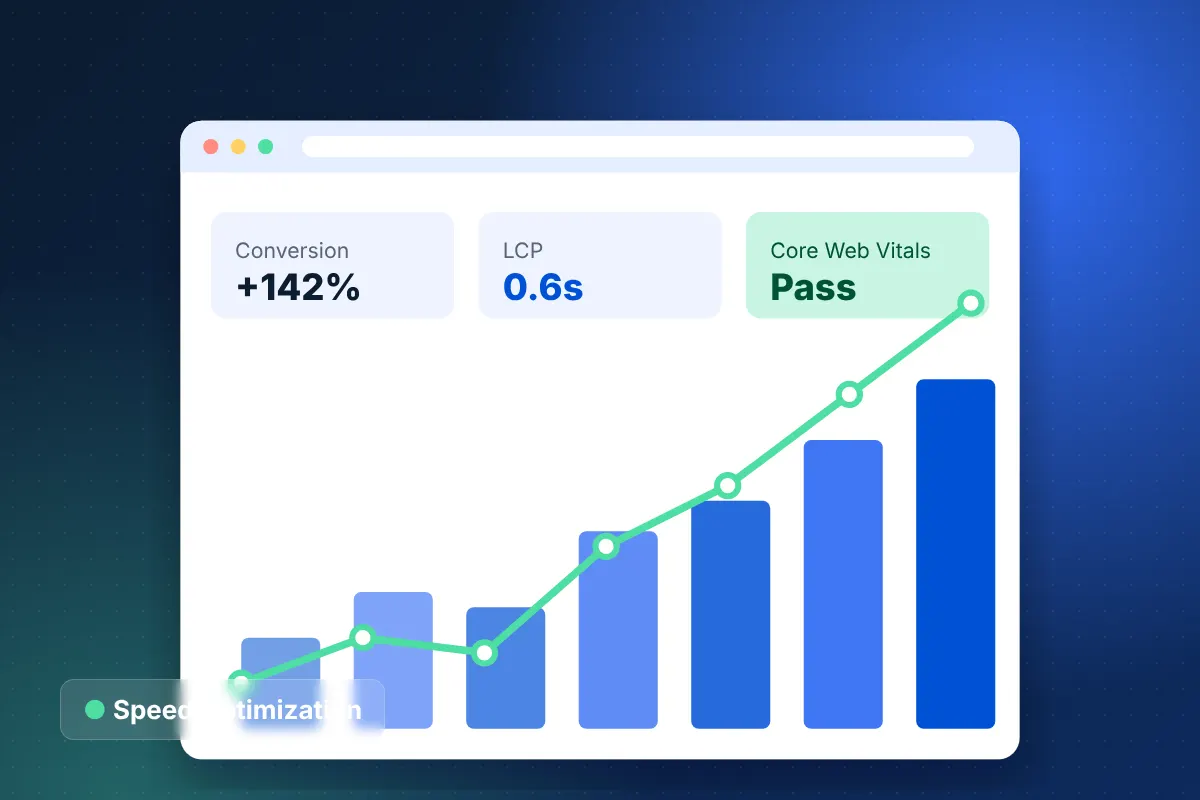
Timelines shorten when the back end already exposes clean APIs and lengthen when catalog data needs restructuring. On our Magento to Shopify Plus migration case study, a headless Next.js front end unified 8 regional stores and reached a 0.6s average page load with a 142% lift in mobile conversion rate.
Why work with a US-based PWA development company
We are a Houston, Texas team with 350+ ecommerce projects delivered across 24+ verticals, and our clients stay with us at a 98% retention rate. Projects run on fixed-price milestone contracts, with a mutual NDA on request and replies within 24 hours.
After launch, our support SLAs include 24/7 monitoring and a 15-minute response to critical issues, which matters when a service worker update needs to roll out quickly. Our processes are ISO 27001 aligned and our cloud setups follow AWS Well-Architected practices.
Get a free progressive web app ecommerce estimate
If your mobile experience is slow or your team is debating a native app, a progressive web app ecommerce storefront may be the faster, leaner path. We will review your analytics and platform and tell you honestly whether a PWA fits.
Book a free 30-minute strategy call to get a free project estimate, or start with the cost calculator to see where your project lands.