How much does custom ecommerce website development typically cost?
expand_more
Custom ecommerce development investments scale depending on architecture complexity, ERP/CRM integration requirements, custom business workflows, and catalog size. Specialized custom stores typically range from $25,000 to $60,000, while complex headless enterprise platforms and multi-region B2B systems start from $60,000 to $150,000+. We provide fixed-price milestone contracts with explicit scope boundaries.
What is the standard development timeline from kickoff to launch?
expand_more
A standard custom ecommerce deployment takes between 8 to 16 weeks across our 6-phase engineering process. Discovery and UX design typically occupy weeks 1–4, backend and headless development span weeks 5–12, and rigorous QA, stress testing, and zero-downtime deployment take place in weeks 13–16.
How do you guarantee zero downtime during replatforming migrations?
expand_more
We execute zero-downtime migrations through dual-database staging synchronization, dry-run cutovers, and parallel DNS traffic shifting. Customers, products, and historic order data are migrated incrementally while active sessions continue uninterrupted on your existing storefront.
Will our existing SEO rankings and Google organic traffic be protected?
expand_more
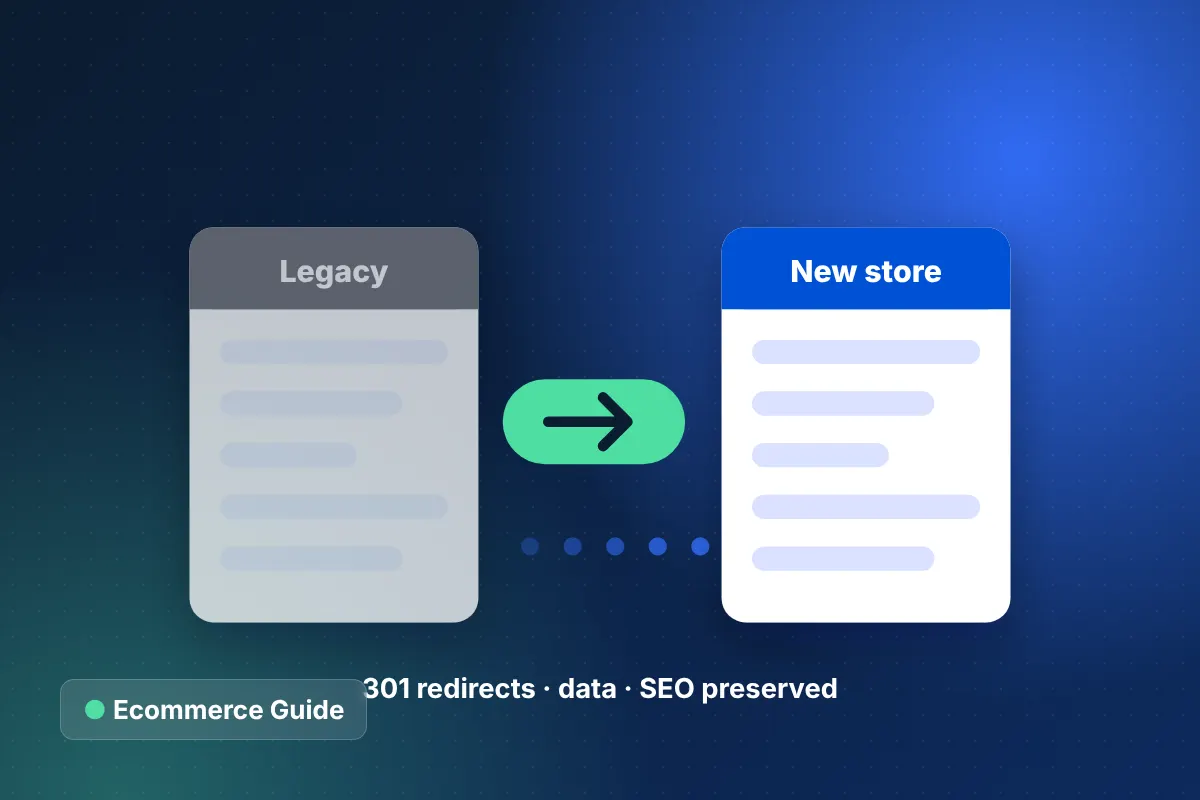
Yes. We perform a complete 1:1 legacy URL crawl, map automated 301 redirects, preserve existing semantic heading structures, and validate structured JSON-LD data prior to launch. Most clients experience an immediate lift in organic rankings post-launch due to vastly improved Core Web Vitals speed scores.
Can you connect our proprietary ERP, WMS, and CRM software?
expand_more
Yes. Integrations are a cornerstone of our practice. We build secure bidirectional middleware for SAP, NetSuite, Oracle, Microsoft Dynamics 365, Salesforce, and custom REST/SOAP endpoints to ensure inventory, pricing, customer tiers, and purchase orders sync in real time.
Who owns the code and intellectual property once the site is completed?
expand_more
You do. Upon project completion and final milestone approval, 100% of all code repositories, design assets, database schemas, and architectural documentation are fully transferred to your company with zero licensing restrictions or vendor lock-in.
Do you provide ongoing support, SLA monitoring, and CRO testing after launch?
expand_more
Yes. We offer Tier-1 Enterprise SLA packages featuring 24/7/365 infrastructure monitoring, guaranteed 15-minute response times for critical incidents, proactive security patching, continuous performance audits, and bi-weekly CRO A/B testing sprints.
Where is your company located?
expand_more
Our office is at 11200 Richmond Ave, Houston, TX 77082, USA. We work with ecommerce brands across Houston, Texas, the wider United States and international markets.
Which ecommerce platforms do you work with?
expand_more
Shopify and Shopify Plus, Adobe Commerce (Magento), WooCommerce, BigCommerce and headless or composable stacks using Next.js, React, GraphQL and commercetools, as well as fully custom builds.
Do you sign an NDA before discussing our project?
expand_more
Yes. Every engagement is protected by a strict mutual NDA, and you can request one before sharing any technical or commercial details.
How quickly will we hear back after requesting a quote?
expand_more
A principal commerce architect reviews every request and responds with a technical feasibility evaluation within 24 hours.
Do you work with B2B and B2C businesses?
expand_more
Both. We build enterprise B2B wholesale portals, dealer hubs and punchout catalogs as well as high-velocity B2C and DTC stores, marketplaces and subscription businesses.