What are manufacturing ecommerce solutions?
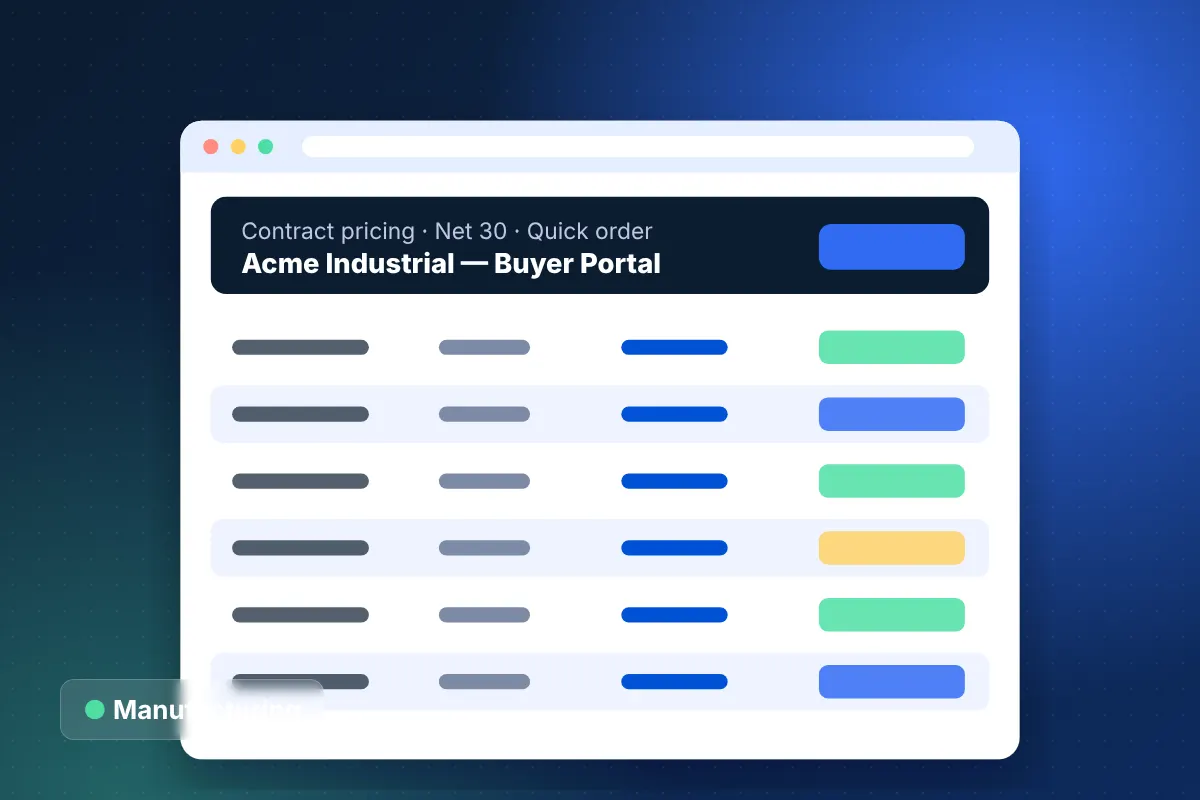
Manufacturing ecommerce solutions are online ordering systems built for how manufacturers actually sell: to known accounts, at negotiated prices, often through distributors and dealers. They replace phone, fax and email orders with a self-service portal connected to your ERP.
Ecommerce for manufacturers is not a consumer store with a login. Buyers are procurement teams, maintenance planners and dealers who reorder known part numbers, need quotes for large jobs and must follow approval rules. The portal has to respect contracts, units of measure and credit terms on every order.
How manufacturing buyers behave
- Repeat, part-number-driven orders: buyers know what they need and want to order it in seconds.
- Negotiated pricing: each account has its own price lists, volume tiers and contract terms.
- Multi-person approvals: requesters, approvers and accounts payable all touch the same order.
- Service and aftermarket demand: replacement parts for installed equipment are often the most profitable channel.
Must-have features in B2B ecommerce for manufacturers
The must-have features mirror what your inside sales team does today, but faster and available around the clock.
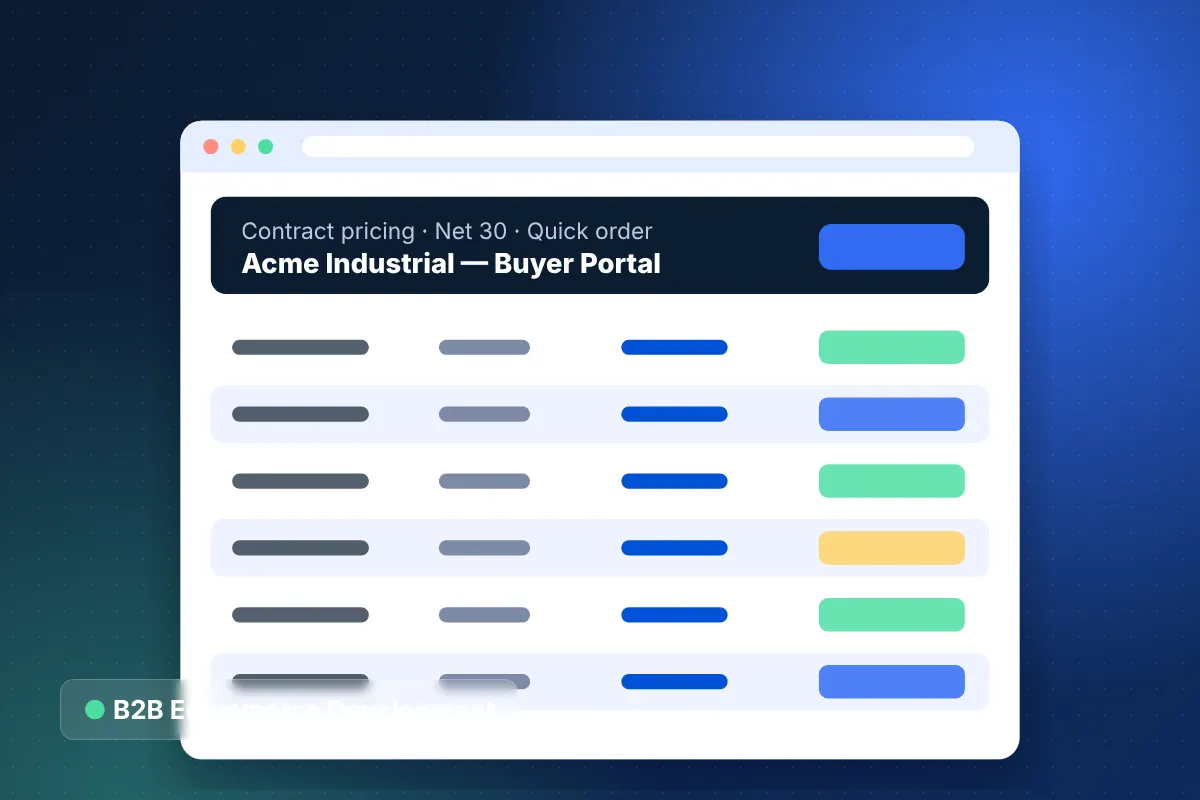
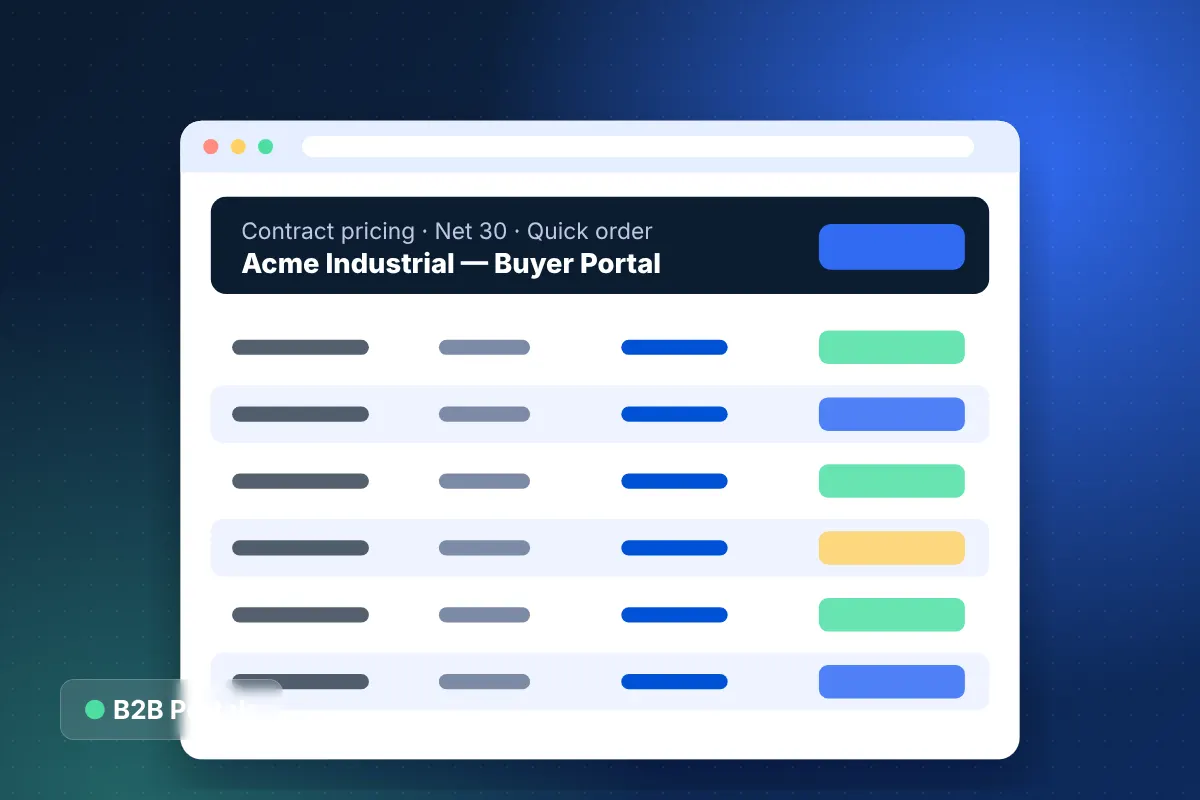
- Account-specific pricing and catalogs: contract prices, tiers and restricted products synced from ERP.
- Interactive parts catalogs: exploded diagrams with clickable callouts that add parts to cart.
- Quick order and reorder: SKU entry, CSV upload and order history templates.
- Request for quote and CPQ: configure equipment and request pricing for large or custom orders.
- Punchout catalogs: cXML and OCI punchout to Ariba, Coupa and other procurement systems.
- Credit terms and PO payments: net terms, purchase orders and invoice payment online.
- Company accounts and roles: buyers, approvers, spending limits and multiple ship-to locations.
- Order, shipment and document tracking: real-time status, invoices, spec sheets and certificates.
Which platform is best for manufacturing ecommerce solutions?
The best platform depends on catalog size, pricing complexity and how deeply the store must integrate with ERP. Most manufacturers choose between Adobe Commerce, BigCommerce B2B Edition, Shopify Plus B2B and custom headless builds.
| Platform | Best for |
|---|---|
| Adobe Commerce B2B | Large catalogs, complex pricing rules and multiple brands or regions |
| BigCommerce B2B Edition | Mid-market manufacturers wanting B2B features with lower overhead |
| Shopify Plus B2B | Manufacturers that sell DTC and wholesale with simpler pricing |
| Salesforce B2B Commerce | Companies already standardized on Salesforce CRM |
| Custom headless portal | Very large SKU counts, punchout and deep SAP or Oracle integration |
Our B2B ecommerce development team will help you choose based on your data, not on a platform preference. We start by sampling real orders, price lists and customer hierarchies, because those reveal the pricing rules and approval chains the platform must support. A short proof of concept against your ERP often settles the decision faster than feature comparisons.
Why ERP integration is the core of ecommerce for manufacturers
ERP integration is the core because pricing, inventory, credit and order status already live there. A portal that does not sync with ERP becomes another system for your team to reconcile by hand.
We build ecommerce ERP integration with SAP S/4HANA, Oracle NetSuite, Microsoft Dynamics 365, Epicor, Infor and others. Pricing and availability are fetched in real time or cached safely, orders post directly into the ERP and status updates flow back to buyers automatically.
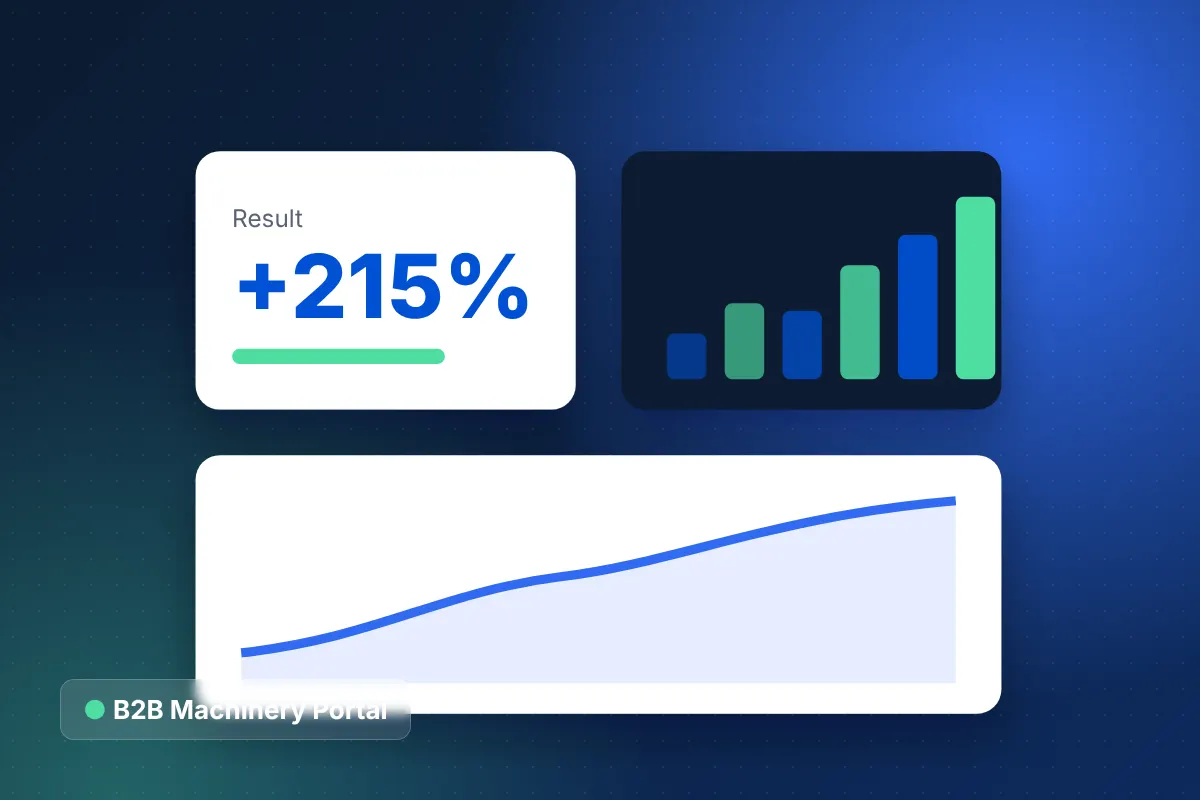
For an industrial OEM with more than 120,000 SKUs, we built a custom B2B punchout store integrated with SAP S/4HANA. Digital order volume rose 215% and the team saved 40 hours a week in admin work. Read the B2B ecommerce case study.
Other integrations manufacturers rely on
- PIM systems for technical attributes, drawings and certifications
- CRM for account data and sales rep visibility
- CPQ engines for configured products
- Procurement networks such as Ariba and Coupa
- Tax, freight and carrier systems for accurate landed cost
Compliance and security considerations for manufacturers
Manufacturers need to protect pricing data, control export-sensitive products and provide the documentation buyers require. Security and access control matter as much as features.
- Role-based access: contract pricing visible only to the right accounts and users.
- Export controls: flags and screening steps for controlled products and restricted destinations, using rules your trade compliance team defines.
- Documentation: safety data sheets, certificates of conformance and material certifications available per order.
- Security: SSO, audit logs and ISO 27001-aligned processes.
- Accessibility: WCAG 2.2 AA portals for every user.
Manufacturing ecommerce built by a Houston team
We are based in Houston, where manufacturing, petrochemicals, energy equipment and the Port of Houston anchor much of the regional economy. That gives our team daily exposure to industrial buyers, ERP-heavy operations and complex distribution, and we bring that experience to manufacturers across the US. See our B2B ecommerce Houston services for local projects.
Builds follow our six-phase process over 8–16 weeks, from Discovery & Strategy through Zero-Downtime Launch. Manufacturing portals with deep ERP integration typically fall in the $60,000–$150,000+ range, while focused parts stores can start at $25,000–$60,000. Every project uses fixed-price milestones, and you own 100% of the code.
Get a free manufacturing ecommerce estimate
If your inside sales team spends its day keying orders from email, it is time for a better channel. Get a starting range from the ecommerce website cost calculator, then book a free 30-minute strategy call to scope manufacturing ecommerce solutions that fit your ERP, pricing and buyers.