What are ecommerce website maintenance services?
Ecommerce website maintenance services keep a live store secure, fast, up to date and available after launch. They cover monitoring, security patching, platform and app updates, backups, bug fixes and small improvements, so your team can focus on selling instead of firefighting.
A store is never really finished. Platforms ship updates, apps change their APIs, payment providers retire old endpoints and browsers change behavior. Without regular maintenance, small issues compound into outages, security exposure and slow pages that quietly cost you orders.
What's included in our ecommerce maintenance and support plans?
Every plan includes proactive monitoring, security, updates and a dedicated support queue. Scope then scales with your platform, traffic, number of storefronts and integrations.
Monitoring and incident response
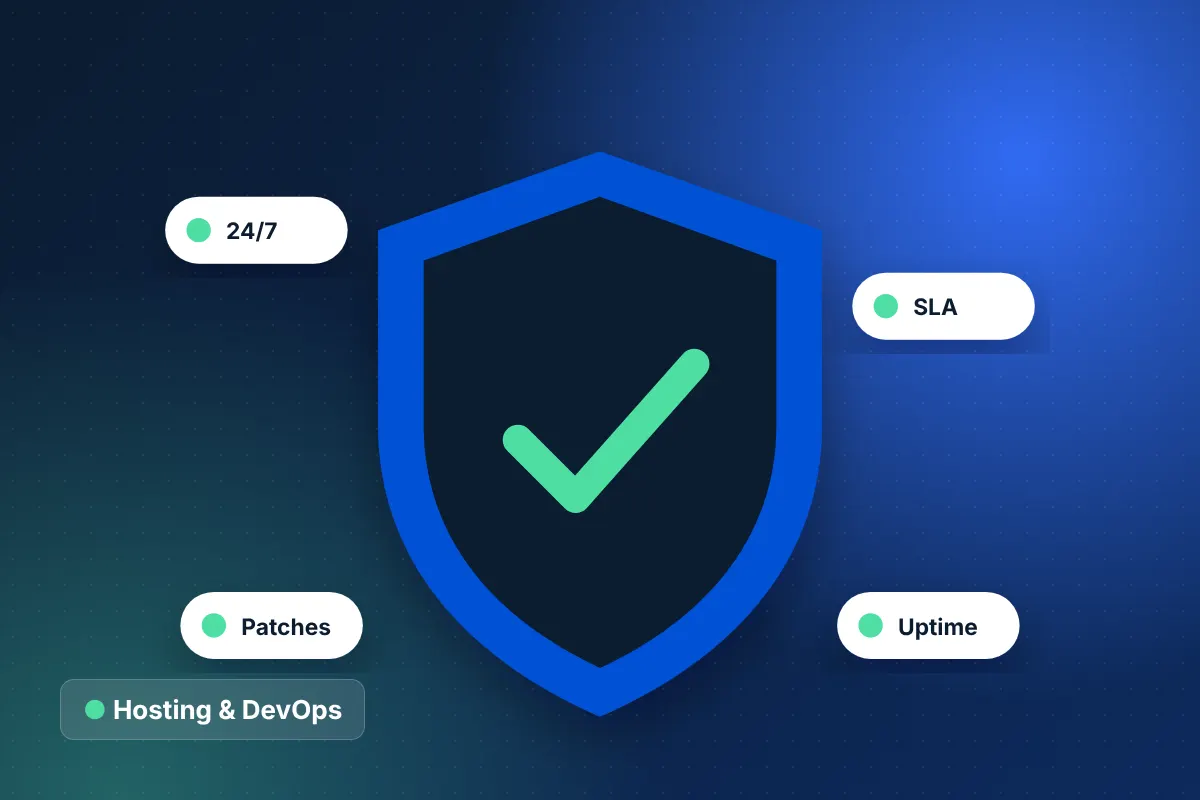
We run 24/7 monitoring of uptime, checkout flows, error rates and integration jobs, with alerts routed to on-call engineers. Critical incidents, such as a failed checkout, payment errors or a site outage, receive a response within 15 minutes, day or night.
How support requests are prioritized
We triage every request by business impact. Anything stopping customers from buying is handled first, around the clock; everything else is scheduled into planned work.
- Critical: site down, checkout or payment failures, or orders not reaching your ERP. 15-minute response, 24/7.
- High: a key feature broken for some shoppers, such as search, a shipping method or a promotion.
- Normal: visual bugs, content template changes and minor errors.
- Planned: enhancements, experiments and upgrades scheduled in your monthly plan.
Security and updates
- Core platform security patches applied promptly on self-hosted platforms.
- Theme, app, plugin and extension updates tested on staging before release.
- Dependency and vulnerability scanning across custom code.
- SSL certificate, DNS and domain expiry checks.
- Quarterly access reviews to remove stale admin and API accounts.
Backups and recovery
Automated backups of code, media and databases are stored off-site, and we test restores on a schedule. A backup you have never restored is only a hope, so recovery is something we rehearse rather than assume.
Bug fixes and small enhancements
Plans include a bank of development time for bug fixes, new landing page sections, content templates, tracking updates and small feature requests. Larger projects are scoped separately so maintenance time isn't swallowed by one big build.
Shopify maintenance vs WooCommerce and Magento maintenance: what's different?
SaaS platforms like Shopify and BigCommerce host and patch the core for you, so maintenance focuses on themes, apps and integrations. Self-hosted platforms like WooCommerce and Magento add servers, PHP versions and core security patches to the list.
| Platform | Who patches the core | Where maintenance effort goes |
|---|---|---|
| Shopify / Shopify Plus | Shopify | Theme updates, app audits, checkout extensibility and API version upgrades |
| BigCommerce | BigCommerce | Stencil theme changes, app reviews, API versioning |
| WooCommerce | Your team or us | WordPress core, plugins, PHP versions, hosting and database cleanup |
| Magento / Adobe Commerce | Your team or us | Security patches, version upgrades, extensions, cache and search services |
| Headless storefronts | Your team or us | Framework upgrades, hosting, API contracts between front end and backend |
WooCommerce maintenance in particular rewards discipline: plugin conflicts are the most common cause of broken checkouts we see. If your store needs deeper work than routine upkeep, our WooCommerce development services team can refactor custom code and consolidate plugins.
Can you take over maintenance of a store you didn't build?
Yes. Most maintenance clients come to us with a store built by someone else. We start with a structured onboarding so we understand the store before we're responsible for it.
- Access and documentation: we collect credentials securely, map environments and document integrations.
- Health check: code review, app and plugin inventory, security scan and performance baseline.
- Monitoring setup: uptime, checkout and error alerting configured before we take on-call duty.
- Risk fixes: urgent issues, such as outdated plugins or missing backups, resolved first.
- Steady state: regular updates, a support queue and monthly reporting.
Onboarding usually surfaces quick wins: unused apps still loading scripts, plugins months behind on security updates or backups that were never tested. Fixing those early often improves speed and stability before any new development begins.
How much do ecommerce website maintenance services cost?
Plans are scoped after a free strategy call based on your platform, number of storefronts, integrations, traffic and how much enhancement time you want each month. We don't quote a one-size monthly fee, because a single Shopify store and a multi-region Magento install with ERP sync carry very different workloads.
The main factors that shape a plan are:
- Platform type: SaaS stores need less infrastructure work than self-hosted ones.
- Number of storefronts, regions, languages and currencies.
- Integrations with ERP, OMS, PIM, marketplaces and subscription tools.
- Monthly development time for enhancements beyond routine upkeep.
- Whether we also manage hosting and infrastructure.
Maintenance is a significant part of total cost of ownership, so it's worth planning for from day one. Our guide on how much does an ecommerce website cost explains how ongoing support fits alongside the initial build budget.
Why proactive ecommerce maintenance protects revenue
Proactive ecommerce website maintenance services catch problems before customers do. Every hour of checkout downtime or a slow product page is lost revenue, and most incidents we investigate had warning signs days earlier.
Performance drifts as apps, tracking scripts and media pile up, so we review Core Web Vitals regularly and bring in ecommerce speed optimization when templates slip past LCP 2.5s or INP 200ms. For self-hosted and headless stores, maintenance pairs naturally with ecommerce hosting on AWS, so one team owns both the application and the infrastructure.
Peak seasons deserve extra planning. Ahead of Black Friday or a major launch, we review capacity, test critical journeys, agree a code freeze window and put engineers on heightened watch, so the busiest days of the year are also the calmest. Good ecommerce website maintenance services make those weeks predictable rather than stressful.
Why choose our ecommerce support team?
You get one accountable engineering partner instead of a rotating help desk, with a named contact who knows your store, your integrations and your calendar. The developers who maintain your store build enterprise ecommerce projects every week, so fixes are done properly rather than patched over.
We've delivered 350+ ecommerce projects over 15+ years and keep 98% of our clients, many through long-term ecommerce support plans. Our team works from Houston, Texas, supports brands across the US and internationally, and operates under ISO 27001-certified processes. We reply to new enquiries within 24 hours, and you keep 100% ownership of your code.
Get a free ecommerce maintenance estimate
Tell us about your platform, integrations and current pain points, and we'll recommend the right level of ecommerce website maintenance services for your store. Book a free 30-minute strategy call to get a free project estimate. Planning a rebuild first? Start with the ecommerce website cost calculator.