How Much Does an Ecommerce Website Cost in 2026? A Practical Breakdown
How much does an ecommerce website cost? For a professionally built store, most specialized custom projects land between $25,000 and $60,000, complex headless or multi-region B2B builds run $60,000–$150,000+, and the smallest agency engagements start around $15,000. Platform, integrations, catalog size and design depth decide where you fall.
 Custom Ecommerce Website Development
Published
Updated 8 min read
Custom Ecommerce Website Development
Published
Updated 8 min read
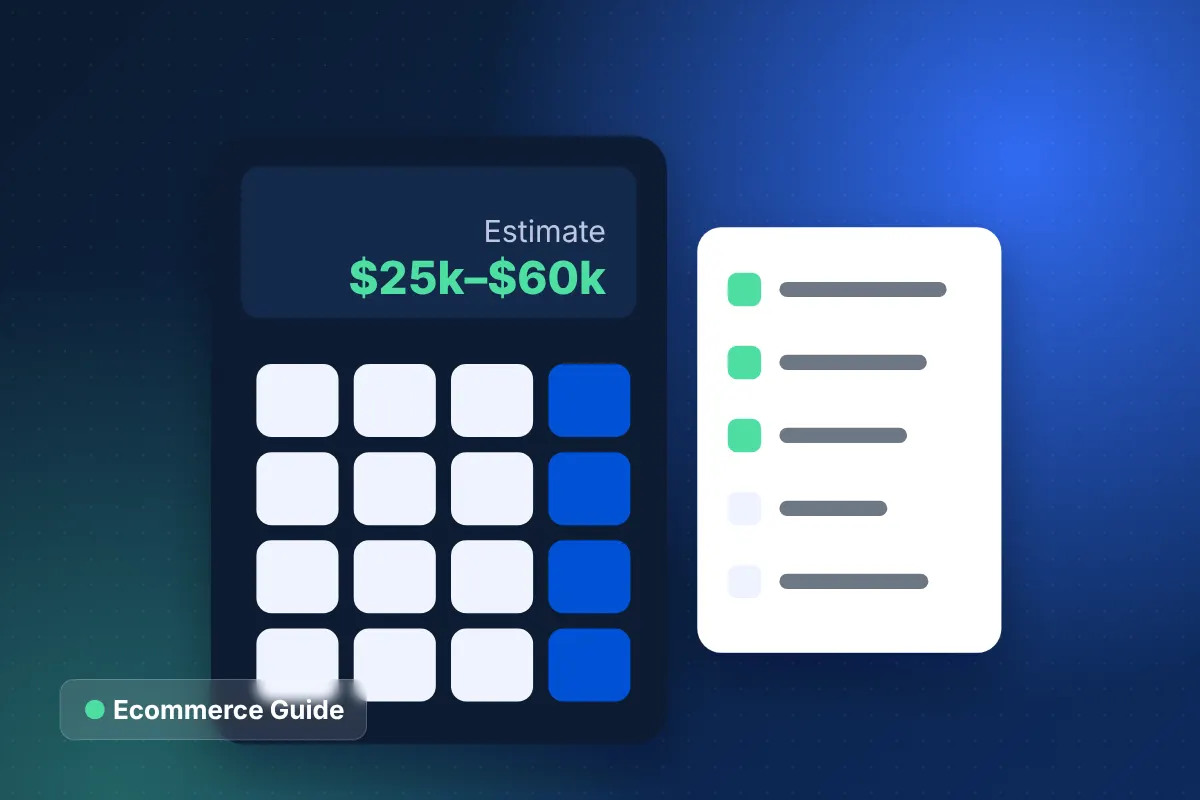
How much does an ecommerce website cost? The honest answer is a range, but it is not a mystery. At Custom Ecommerce, our smallest engagements start around $15,000, most specialized custom stores land between $25,000 and $60,000, and complex headless or multi-region B2B builds run $60,000 to $150,000+. Where your project falls depends on a handful of predictable factors.
This guide breaks down those factors, explains the recurring costs that come after launch, and shows where you can save without hurting conversion. If you want a number for your own store right now, run your requirements through our ecommerce website cost calculator and you will get a ballpark in about two minutes.
How much does an ecommerce website cost in 2026?
A professionally built ecommerce website costs roughly $15,000 to $150,000+ when you work with an agency. The spread is wide because "ecommerce website" covers everything from a focused DTC store to an ERP-connected B2B portal with 100,000 SKUs.
Here is how our price bands map to typical projects:
- From around $15,000: a focused store on a SaaS platform with a customized theme, standard checkout, core apps and a clean product catalog.
- $25,000–$60,000: specialized custom stores with bespoke design, custom features (bundles, subscriptions, product configurators), several integrations and data migration from an existing platform.
- $60,000–$150,000+: headless storefronts, multi-region or multi-currency operations, B2B portals with customer-specific pricing, and deep ERP, PIM or OMS integrations.
Treat these bands as a starting point rather than a menu. Your own answer to how much does an ecommerce website cost comes from the mix of factors below, not from page count alone.
Every project we deliver uses fixed-price milestone contracts, so the number you approve after discovery is the number you pay. An exact quote always needs a short discovery conversation, because two stores with the same page count can differ by tens of thousands of dollars in integration work.
What factors decide how much an ecommerce website costs?
Six factors account for most of the variation in ecommerce development pricing: platform choice, design depth, catalog complexity, integrations, custom functionality and migration scope. The table below shows how each one moves the budget.
| Cost factor | Lower-cost scenario | Higher-cost scenario | Budget impact |
|---|---|---|---|
| Platform | Hosted SaaS (Shopify, BigCommerce) with a standard plan | Adobe Commerce, headless or fully custom stack | High |
| Design | Customized premium theme | Bespoke UX research, custom design system, many unique templates | Medium to high |
| Catalog | Hundreds of SKUs, simple variants | Tens of thousands of SKUs, complex options, multiple price lists | Medium |
| Integrations | Payments, email marketing, shipping apps | ERP, PIM, OMS, CRM, punchout, custom middleware | High |
| Custom features | Out-of-the-box apps and extensions | Product configurators, custom checkout logic, B2B quoting | Medium to high |
| Migration | New store, no legacy data | Years of orders, customers, reviews and SEO redirects to move | Medium |
| Markets | One country, one currency | Multi-region storefronts, languages, tax and duties | Medium to high |
Integrations are the most underestimated line item. Connecting a store to an ERP such as NetSuite or SAP means mapping inventory, pricing, orders and customer records in both directions, and that work is often bigger than the storefront itself. Our ecommerce ERP integration team scopes this separately during discovery so it never surprises you later.
Does the platform change the price?
Yes. Hosted SaaS platforms remove hosting, security patching and core checkout development from your build budget, which is why many growing brands start with Shopify development services. Open-source or enterprise platforms give you more control but add engineering, hosting and maintenance effort. If you are still deciding, our comparison of Shopify vs WooCommerce walks through the trade-offs.
What does custom ecommerce website development include?
A full custom build covers strategy, design, engineering, testing and launch, not just "making pages." Knowing what is inside the price helps you compare quotes fairly.
Our custom ecommerce website development follows a six-phase process across a typical 8–16 week timeline:
- Discovery & Strategy (weeks 1–4, alongside design): requirements, integrations map, platform fit and a fixed-price scope.
- Conversion UX/UI Design: wireframes and high-fidelity designs for key templates such as home, collection, product, cart and account.
- Architecture & API Engineering: data models, integration contracts and performance budgets.
- Custom Development (roughly weeks 5–12): theme or storefront build, custom features, app configuration and data migration.
- Testing & Optimization (weeks 13–16): QA across devices, accessibility checks against WCAG 2.2 AA, and Core Web Vitals tuning toward LCP ≤ 2.5s, INP ≤ 200ms and CLS ≤ 0.1.
- Zero-Downtime Launch: redirects, DNS cutover, monitoring and hypercare.
When comparing proposals, check whether each one includes discovery, accessibility, performance work and redirects. A cheaper quote that skips these usually costs more after launch. You also own 100% of the code and IP we produce.
How does project timeline affect ecommerce website cost?
Most builds take 8–16 weeks, and timeline is closely tied to cost because both reflect scope. Compressing a timeline usually means adding engineers in parallel, which raises the budget.
Simpler SaaS stores sit toward the 8-week end. Projects with ERP integration, B2B logic or multiple regions take the full 16 weeks or are split into phases. Rushing QA or launch is the most common way projects go over budget, because defects found after launch cost more to fix.
When people ask how much does an ecommerce website cost, they often forget the cost of time. A realistic schedule with room for content entry, product photography and stakeholder reviews is cheaper than a compressed one that needs rework. Build those internal tasks into your plan from the start.
What are the ongoing costs of running an online store?
Ongoing costs typically include platform fees, apps or extensions, payment processing, hosting (for self-hosted platforms) and maintenance. Budget for them before launch so year one does not surprise you.
The cheapest build is rarely the cheapest store. Count the platform fees, the apps and the maintenance hours you'll pay for three years, then compare.
Custom Ecommerce architecture team
- Platform subscription: SaaS platforms charge a monthly plan, with higher tiers adding features like advanced reporting, more staff accounts or B2B tools. Enterprise tiers such as Shopify Plus are custom-quoted.
- Payment processing: every gateway charges per-transaction fees, and some platforms add their own fee if you use a third-party gateway.
- Apps and extensions: reviews, subscriptions, search, loyalty and shipping tools are often monthly subscriptions that add up quickly.
- Hosting and infrastructure: self-hosted platforms like WooCommerce and Magento need managed hosting, CDN, backups and security monitoring.
- Maintenance and support: platform updates, security patches, bug fixes and small enhancements.
- Growth work: SEO, CRO testing, analytics and new features.
Our ecommerce website maintenance services include 24/7 monitoring and a 15-minute response for critical issues, which keeps those post-launch costs predictable rather than reactive.
How can you control ecommerce website cost without hurting results?
The most effective way to control cost is to narrow scope to what drives revenue at launch and phase everything else. Cutting quality on checkout, speed or accessibility almost always backfires.
Practical ways to keep your budget in check:
- Start on a SaaS platform when it fits. Hosted platforms absorb hosting, security and checkout infrastructure.
- Customize a strong theme instead of designing every template from scratch. Reserve bespoke design for the pages that convert: product, collection and cart.
- Use proven apps before custom code. Build custom only where an app genuinely cannot meet the requirement.
- Phase integrations. Launch with the critical ERP or inventory sync, then add CRM, PIM or loyalty in phase two.
- Clean your data before migration. Removing dead SKUs and duplicate customers reduces migration effort.
- Lock scope with a fixed-price milestone contract. Clear milestones prevent open-ended hourly billing.
- Plan for maintenance from day one. A small retainer is cheaper than emergency fixes.
Is a custom ecommerce website worth the higher cost?
A custom build is worth it when your business model, catalog or operations do not fit a template. If an off-the-shelf theme already serves your customers well, a lighter build is usually the smarter spend.
Custom work pays back fastest in a few situations:
- Your conversion rate is held back by slow pages or a generic mobile experience.
- Staff spend hours each week re-keying orders between the store and an ERP.
- B2B buyers need account-specific pricing, quotes or punchout.
- You sell across regions and need localized storefronts managed centrally.
Two examples from our work: a luxury apparel brand that moved from a Magento monolith to headless commerce development on Shopify Plus saw +142% mobile conversion rate and a 0.6s average page load, as documented in our Magento to Shopify Plus migration case study. An industrial OEM with 120,000+ SKUs gained +215% digital order volume and saved 40 admin hours per week after we built an SAP-integrated B2B store.
How much does it cost to migrate an existing ecommerce site?
Migration cost depends on how much data you move, how many URLs need redirects and how different the new platform's data model is. It is usually a meaningful share of a replatforming budget rather than a small add-on.
Migrations involve products, variants, customers, order history, reviews, content pages and a complete 301 redirect map to protect organic rankings. Moving from Magento to Shopify, for example, often means remodeling configurable products and rebuilding extensions as apps. Our ecommerce migration services scope these tasks during discovery and run them inside the same fixed-price milestones as the build. Read our ecommerce migration SEO checklist before you plan a cutover.
Get a free ecommerce website cost estimate
So, how much does an ecommerce website cost for your business? Start with our ecommerce website cost calculator for an instant range, then book a free 30-minute strategy call with our team. We will review your platform, integrations and catalog, and send a free project estimate with fixed-price milestones. We reply within 24 hours and sign a mutual NDA on request.
Frequently asked questions
What is the cheapest way to build an ecommerce website?
Why do ecommerce website quotes vary so much between agencies?
How much should I budget for ecommerce maintenance each year?
Does a B2B ecommerce website cost more than a B2C store?
Can I get a fixed price for my ecommerce website?
About the author
Custom Ecommerce Website Development is the editorial team at Custom Ecommerce Website Development, a Houston ecommerce development agency with 350+ enterprise projects across Shopify, WooCommerce, Magento, BigCommerce and headless commerce.
Services related to this article
Custom Ecommerce Website Development for Brands That Outgrow Templates
Bespoke online stores engineered around your catalog, pricing and integrations, with full code ownership.
Learn more
Ecommerce Website Redesign Without Losing SEO or Sales
Data-led store redesigns that lift mobile conversion and speed while protecting rankings with full URL and redirect mapping.
Learn more
Jewelry Ecommerce Website Development for Fine and Luxury Brands
Fine jewelry and luxury stores with ring builders, certified diamond search, virtual appointments and insured shipping.
Learn more