Why move from WooCommerce to Shopify?
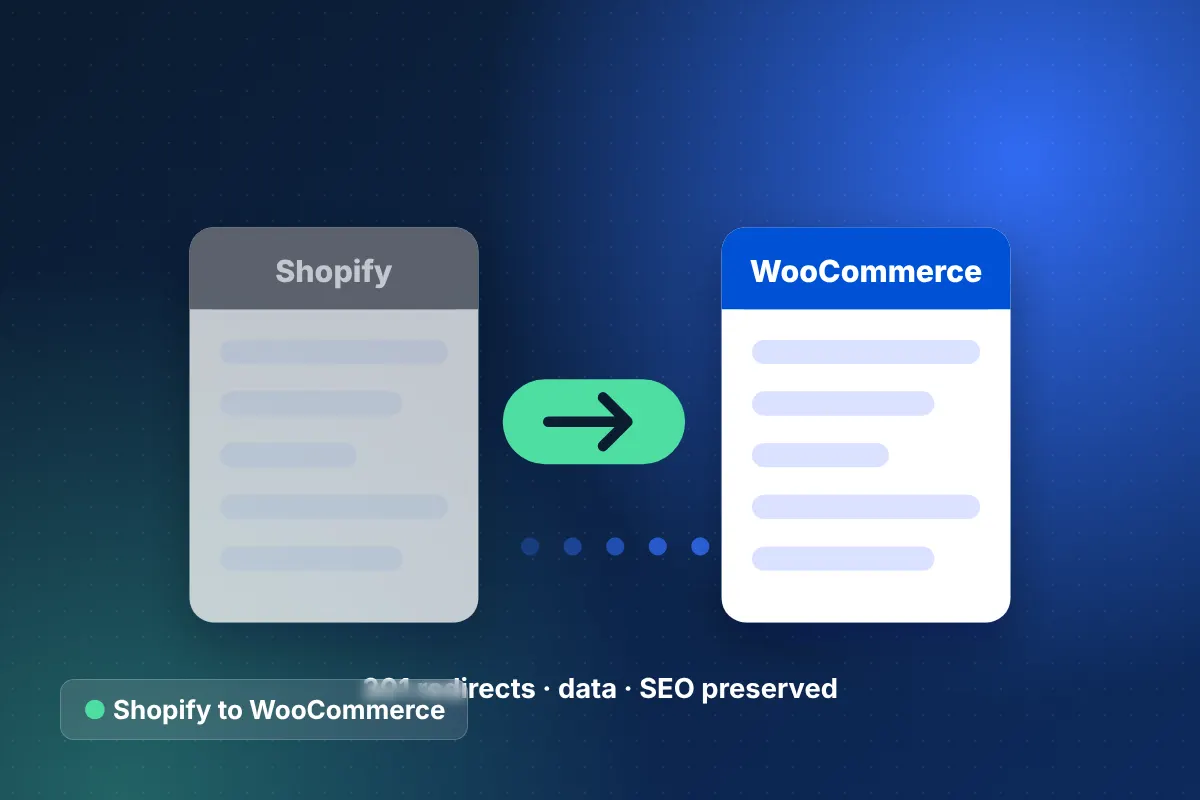
Stores usually choose a WooCommerce to Shopify migration when keeping WordPress, hosting and dozens of plugins stable takes more time than selling. Shopify handles hosting, checkout security and core updates, so your team focuses on products and marketing.
WooCommerce is flexible and has no platform fee, which is why many brands start there. As order volume grows, the hidden costs show up: managed hosting upgrades, plugin licenses, update testing, caching problems and the occasional checkout outage after an update. Shopify's predictable subscription and fast hosted checkout with Shop Pay often outweigh that flexibility for growing DTC brands.
If you are still weighing the decision, our Shopify vs WooCommerce guide compares cost, control and scalability side by side.
What data moves in a WooCommerce to Shopify migration?
We migrate products, customers, orders, URLs, reviews and WordPress content. WooCommerce's flexible data, much of it stored by plugins, is mapped into Shopify's structure with metafields where needed.
| Data | What we migrate | How it maps in Shopify |
|---|---|---|
| Products | Simple and variable products, attributes, images, SKUs, stock, sale prices, Yoast or Rank Math SEO fields | Products and variants; custom fields and ACF data become metafields |
| Customers | Accounts, billing and shipping addresses, marketing consent | Customer records; passwords cannot transfer, so customers reactivate by email |
| Orders | Order history, line items, totals, statuses, notes | Archived historical orders linked to customers |
| URLs and 301s | /product/, /product-category/, page and blog post URLs | Redirects to /products/, /collections/, /pages/ and /blogs/ paths |
| Reviews | WooCommerce or plugin reviews with ratings and dates | Imported into a Shopify reviews app and matched by SKU |
| Content | Blog posts, categories, pages, images | Shopify blog articles and pages, with internal links updated |
Active WooCommerce Subscriptions need special handling. Where your payment gateway allows it, we move payment tokens to a Shopify subscription app so subscribers continue without re-entering cards.
How do we keep SEO safe when moving WooCommerce to Shopify?
We keep SEO safe by redirecting every WooCommerce and WordPress URL, migrating content and metadata, and rebuilding internal links. Blog content is often a large share of organic traffic on WordPress sites, so it gets the same care as products.
- Crawl the site and pull top URLs from Search Console and analytics.
- Map product, category, tag, page and blog post URLs one-to-one with 301 redirects.
- Carry over SEO titles and descriptions from Yoast or Rank Math.
- Update internal links inside blog posts to point at new Shopify URLs directly.
- Recreate structured data, XML sitemaps and canonical tags, then monitor rankings after launch.
Our ecommerce migration SEO checklist covers the complete pre-launch and post-launch routine.
Our step-by-step WooCommerce to Shopify migration process
A WooCommerce to Shopify migration typically fits inside our 8 to 16 week delivery window. Smaller stores with a ready theme sit at the short end.
- Plugin and data audit: list every plugin, what it does and where its data lives.
- App mapping: choose a Shopify feature or app for each plugin, removing what is no longer needed.
- Theme and UX: design and build a fast Shopify theme that matches or improves your brand.
- Test migration: import all data to a development store and reconcile products, prices and variants.
- Integrations: connect payments, shipping, email, accounting and fulfillment.
- SEO QA: test redirects, metadata and structured data on staging.
- Final sync and launch: migrate new orders and customers, switch the domain and verify checkout.
- Aftercare: monitor 404s, rankings, conversion and customer activations.
What are the risks of WooCommerce to Shopify migration, and how do we avoid them?
The biggest risks are hidden plugin functionality, messy product data, lost blog traffic and subscriber disruption. We surface each one in the audit, before a single record moves.
Hidden plugin logic
Shipping rules, pricing tweaks and checkout fields often live in small plugins nobody remembers installing. We document them all so nothing quietly disappears at launch.
Inconsistent product data
WooCommerce allows free-form attributes, which leads to duplicates such as "Large" and "L". We clean and standardize data during the test migration so Shopify filters work properly.
Blog and content traffic loss
Prevented with full content migration, updated internal links and redirects for every post, category and tag URL that earns traffic.
Subscription and payment interruptions
We plan token migration with your gateway and test renewals before cutover so subscribers are never double-charged or dropped.
What should you prepare before migrating WooCommerce to Shopify?
The best preparation is a clear picture of what your store does today and what it should do after the move. A short list of priorities keeps scope under control and avoids rebuilding features nobody uses.
- Admin access to WordPress, hosting, your payment gateway and Google Search Console.
- A list of plugins you know are business-critical, such as shipping rules, B2B pricing or product add-ons.
- Details of integrations with accounting, ERP, fulfillment and email marketing tools.
- Your peak sales dates, so launch avoids promotions and seasonal spikes.
It is also worth deciding what not to migrate. Very old orders, inactive customer accounts and discontinued products with no traffic can often be archived instead, which speeds up import and keeps the new store clean. We agree these rules with you in writing.
We handle the rest, including the crawl, data export and redirect map. A short freeze on large catalog edits during the final week keeps the last data sync clean.
How much does a WooCommerce to Shopify migration cost?
Focused WooCommerce to Shopify migrations start around $15,000, and most custom projects fall between $25,000 and $60,000. Price depends on catalog size, plugin replacement, content volume, subscriptions and design scope. Our Shopify development services team builds the new store, while our ecommerce migration services team owns data, redirects and cutover. We are based in Houston, Texas and work with stores across the US and internationally on fixed-price milestones.
Start your WooCommerce to Shopify migration
If plugin updates and hosting issues are slowing your growth, a planned WooCommerce to Shopify migration gives your team a stable platform without losing data or rankings. Book a free 30-minute strategy call to review your store, or get a quick estimate from the ecommerce website cost calculator.