A customer support AI chatbot for ecommerce answers shoppers’ questions about orders, returns, shipping and products around the clock, using your store’s own data and policies, and hands the conversation to a person whenever it should. Done well, it resolves routine tickets in seconds while your team focuses on the conversations that need judgment.
What is a customer support AI chatbot for ecommerce?
It is a chat assistant on your store, built on a large language model and connected to your order system, product catalog and help-center content. Unlike a scripted bot with fixed buttons, it understands questions in the shopper’s own words and language, looks up the facts it needs, and answers only from your approved information.
What can an ecommerce customer service AI chatbot handle?
- Order status and tracking: “Where is my order?” answered from live order and carrier data after verifying the customer.
- Returns and exchanges: policy questions, eligibility checks and starting a return in your returns portal.
- Shipping and delivery: rates, cut-off times, regions and delivery estimates.
- Product questions: sizing, compatibility, ingredients or specs, with links to the right product.
- Account and subscription help: skip, pause or update a subscription, reset access, update addresses.
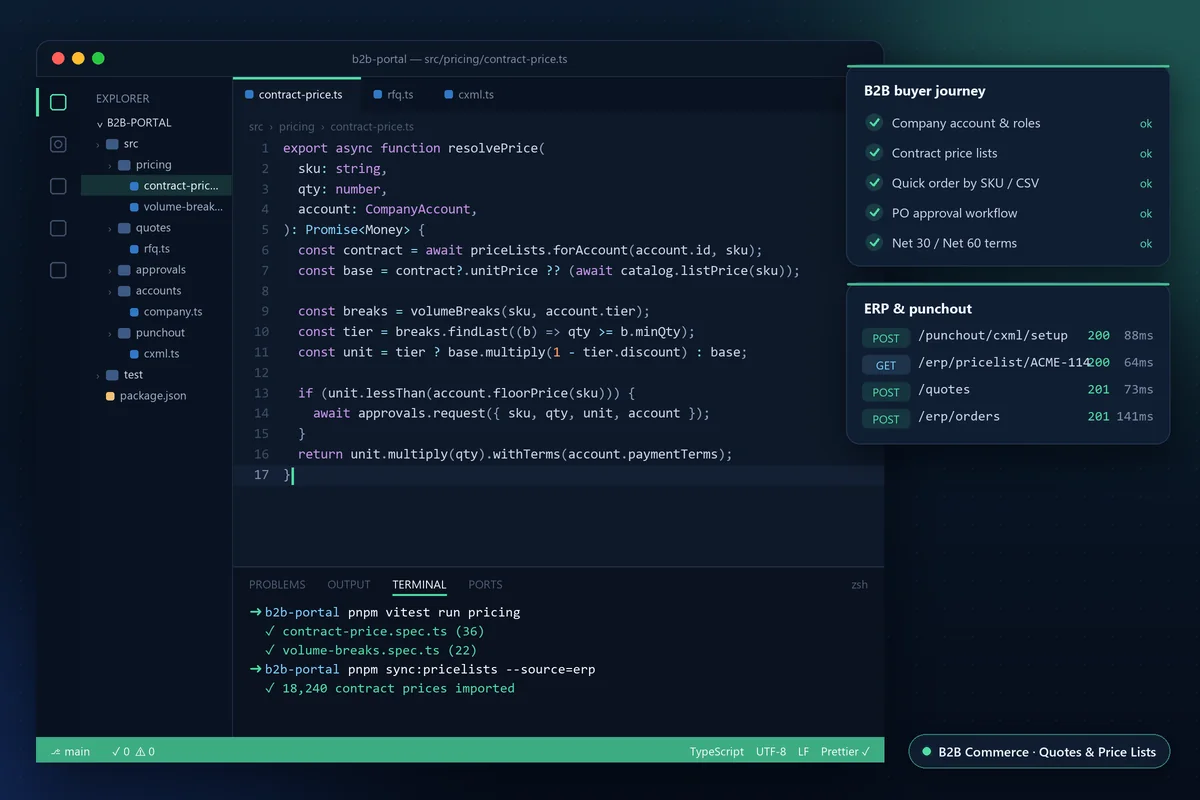
- B2B questions: price lists, minimum orders and quote requests for logged-in trade customers.
- Lead capture: collecting contact details and project needs when a visitor is ready to talk to sales.
Our customer service AI chatbot development service for ecommerce: how it works
- Discovery: we review your ticket history to find the questions worth automating and agree on success metrics, such as resolution rate and handoff quality.
- Knowledge and data: we connect approved sources: policies, help articles, product data and order lookups through your platform’s APIs.
- Guardrails: the assistant answers only from those sources, says when it does not know, never invents policies or prices, and follows rules for sensitive requests.
- Human handoff: a request for a person, a frustrated customer or a complex case goes straight to your team in your help desk, with the full conversation attached.
- Testing and launch: we test against real past questions, launch to a share of traffic first, then tune answers using transcripts and feedback.
AI chatbot vs scripted chatbot vs live chat
| Option | Strengths | Limits |
|---|---|---|
| Scripted (rule-based) chatbot | Predictable, cheap to run | Breaks on questions outside its buttons and keywords |
| AI customer support chatbot | Understands any wording and language, answers from your data, available 24/7 | Needs good source content, guardrails and monitoring |
| Live chat with agents only | Human judgment on every conversation | Limited hours, waiting times and staffing cost |
Most stores get the best result from an AI assistant that handles routine questions and passes everything else to live agents.
Which platforms and help desks do we integrate?
We connect the assistant to Shopify and Shopify Plus, Adobe Commerce (Magento), WooCommerce, BigCommerce and headless stores, and to help desks and tools such as Zendesk, Gorgias, Freshdesk and HubSpot. Order lookups, returns and handoffs run through those systems’ own APIs, so your team keeps working where it already does.
How do you keep an ecommerce AI chatbot accurate and safe?
- Answers are grounded in your approved content; the assistant says so when the answer is not there.
- Order details are shown only after the customer is verified.
- Requests for a person are handed over immediately, without detours.
- Conversations are logged so your team can review answers and improve the knowledge base.
Which support questions should an ecommerce AI chatbot automate first?
Start with questions that are frequent, have one correct answer and can be checked against your data. In most stores that means a short list:
- Where is my order? Usually the largest single share of support tickets, and fully answerable from order and carrier data.
- Returns and exchanges: eligibility, deadlines and how to start a return.
- Shipping questions: costs, regions, cut-off times and delivery estimates.
- Product fit questions: sizing, compatibility and “which one should I buy?” with links to products.
- Subscription changes: skip, pause, swap or change the delivery date.
Refund disputes, damaged-item claims, complaints and anything involving payment details should go to a person from the start. Your ticket history shows which questions to automate first; we review it with you in discovery.
How much does an ecommerce AI chatbot cost?
Focused AI projects start around our $15,000 minimum engagement, and AI assistants are often delivered within larger store builds in the $25,000 to $60,000 range. After launch, the main running cost is the AI model usage, which grows with conversation volume.
How long does it take to build a customer support AI chatbot?
A first release usually fits inside our typical 8–16 week project window. A support assistant on one platform with clean policies and order data sits at the shorter end; several stores, languages or help desks take longer.
Get a free AI chatbot estimate
Book a free 30-minute strategy call and share the questions your support team answers most. We will outline what an AI assistant could resolve for your store, how it hands over to your team, and a fixed-price estimate. For a quick budget range, try the ecommerce cost calculator.